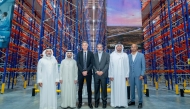
Sheikh Dr. Khalid bin Thani bin Abdullah Al Thani (second left), QIIB Chairman and Managing Director; Rashid Nasser Al Kaabi (left), QIIB Vice-Chairman; Sheikh Abdullah bin Thani bin Abdullah Al Thani (right) Board Member, QIIB; and Dr. Abdul Basit Al S
QIIB Chairman and Managing Director Sheikh Dr. Khalid bin Thani bin Abdullah Al Thani said yesterday that QIIB had diversified its investments and financing portfolios in 2019 as much as possible in order to aver potential risks. This helped the bank to strengthen its position as a leading bank, maintain stable growth, provide best returns for it s shareholders and maintain a good rating from the international rating agencies, Sheikh Dr. Khalid said while addressing QIIB’s Ordinary General Assembly Meeting, yesterday.
The Chairman, who said that QIIB had worked closely with the various economic sectors in the country in 2019, noted that the bank worked wisely in order to achieve its goal while relying on the support, vision and guidance of the Amir H H Sheikh Tamim bin Hamad Al Thani.
Sheikh Dr. Khalid said: “It is worth noting that last year, as in the previous years, the Qatari banking sector was full of activity and competitiveness. We participated in the financing of many projects, such as infrastructure projects, large projects and SMEs, and we are satisfied with what we have accomplished in this respect, which is an essential aspect of our work.”
QIIB was able to maintain its strong financial position and stable growth. It also built partnerships with different investment dimensions abroad based on its reputation and the great reputation of the Qatari economy. QIIB’s results for 2019 show that the bank is moving forward, benefiting from the strength of the Qatari economy, which is achieving the best results in all sectors.
Sheikh Dr. Khalid noted that QIIB strengthened its capital by issuing sukuks so as to keep pace with the global and economic developments in the banking and financial sector. The Bank also encouraged Qatari competencies to work in the banking sector, providing them with all necessary incentives.
Keen to meet the requirements of the regulatory and supervisory authorities, QIIB reviewed all its policies and procedures in line with the laws, legislations and regulations, in particular the good governance and sound management policy, as per the requirements of Qatar Central Bank and Qatar Financial Markets Authority, the latest of which was QFMA Governance Code for companies listed on the financial market.
“At QIIB, we are proud of the growth we achieved as it reflects our involvement in the Qatari economy, which has been built on strength and rigidity. (In 2019) QIIB continued to focus on the local market given the significant opportunities that contribute to the country’s development and achievement of the goals set in Qatar National Vision 2030, some of which have already been achieved, while others are being achieved. We are honoured to take part and actively contribute to achieving some of these goals”, Sheikh Dr Khalid said.
Addressing the meeting, QIIB CEO Dr Abdulbasit Ahmed Al Shaibei, said the bank strived during the past year to implement the interim and strategic plans laid down by the Board of Directors. ''We worked hard to achieve better results. The outcomes were satisfactory, as most of the bank’s financial indicators improved, the bank’s established position kept its strength while the bank’s confidence index rose.
Credit rating companies affirmed QIIB high ratings with a stable outlook based on a number of factors, namely the strength of the bank’s position among Islamic banks, the quality of its assets, strong profitability, quality of financing portfolio, growth in operational revenues and improvement in operational efficiency.
Great efforts were made during 2019 to improve the bank’s response to the customers’ requirements and upgrade its services and products in line with the best global standards.
The general assembly meeting approved all the items on the agenda, including the Board of Directors’ recommendation to distribute 42.5 percent of the bank capital as cash dividends .