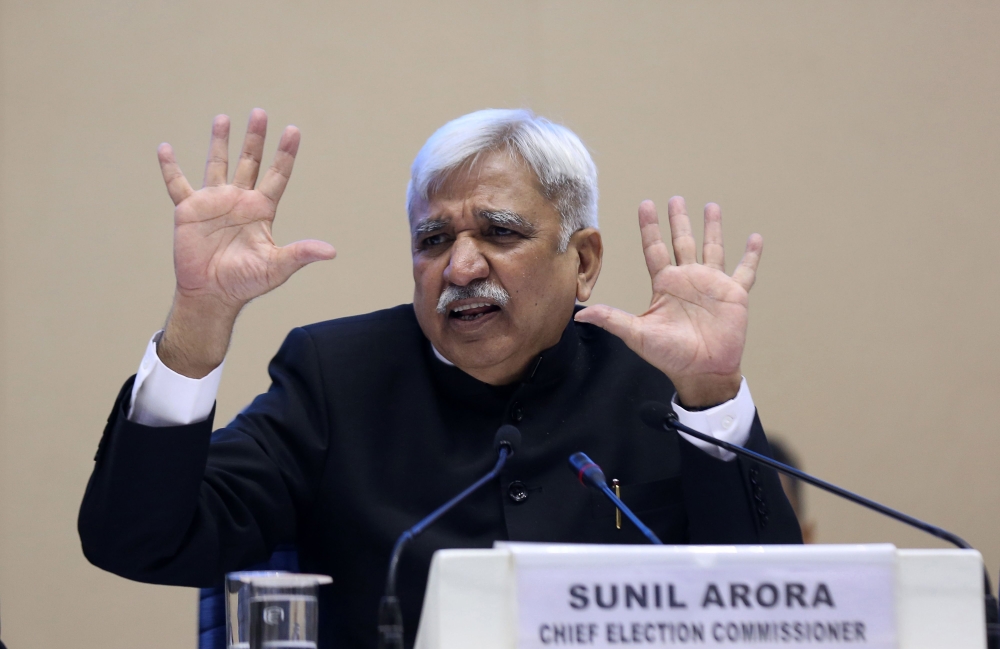
India's Chief Election Commissioner Sunil Arora speaks during a press conference in New Delhi on March 10, 2019. AFP
New Delhi: India is not just the world's biggest democracy, its elections are also the most gruelling -- with nearly six weeks between the first round of voting on April 11 and the last.
Rival politicians are permanently at daggers drawn and if Prime Minister Narendra Modi is to win another five-year mandate, he will either have to beat opponents or tempt them into an alliance.
Here are the key players to watch as the 2019 campaign battle starts:
India's tough guy
Narendra Modi has risen to become one of India's most popular and polarising leaders ever.
The 68-year-old son of a street tea seller guided the Hindu nationalist Bharatiya Janata Party (BJP) to a landslide victory in 2014 to form the country's first majority government in almost three decades.
Five years on, now it is Modi who must defend his record amid mounting opposition criticism of controversial economic policies.
Flagship policies -- including new taxes and the cancellation of huge numbers of banknotes -- have not produced promised jobs, while India's farmers are up in arms over massive debt burdens.
Modi portrays himself as a strong leader and India's military action against Pakistan last month has given him a new boost.
All in a name
Rahul Gandhi is the scion of the Nehru-Gandhi dynasty, which has provided three prime ministers since India's independence in 1947.
The 48-year-old son of assassinated premier Rajiv Gandhi heads the opposition Congress party, which badly needs to make an impact in this election after its worst-ever electoral performance in 2014.
He gained some political capital by wresting three key states from Modi's BJP at the end of 2018.
But there are still doubters who say the Harvard and Cambridge student has not put up strong enough alternative policies to the Modi machine.
The Gandhi name will be both a boon and a burden as he seeks alliances crucial to maintaining the family grip on power.
Power behind the throne
Amit Shah is neither a lawmaker nor a government minister, but many say he is the second-most powerful person in India.
As president of the BJP, the 54-year-old Shah is Modi's enforcer, closest aide and most-trusted lieutenant.
Having trained as a biochemist and stockbroker, Shah has been mixing and gambling with Modi's political campaigns for decades.
Admirers say Shah has been the architect of the BJP's rapid expansion outside its traditional support base. Opposition parties accuse him of using unfair and undemocratic tactics.
While a minister in Modi's Gujarat state government, Shah was accused of ordering police to carry out three extrajudicial killings in 2005. A judge cleared him for lack of evidence in 2014.
Shah has spent much of the time since plotting the campaign for Modi's second term, and he will have a central role in the coming weeks.
The breakaway
If both the BJP and Congress fail to get a decisive share of the 545 parliamentary seats, West Bengal chief minister Mamata Banerjee could become one of the top contenders for the prime minister's job.
After founding a breakaway party from Congress, 64-year-old Banerjee swept to power in 2011 ending decades of communist and left-wing rule -- but has adopted equally statist policies.
Banerjee's party took most of the state's 42 parliamentary seats in 2014, giving her a national profile.
The BJP has campaigned hard against her in the state, fearing she could lead a possible alliance of India's disparate regional parties.
The Dalit
Mayawati is the former chief minister of Uttar Pradesh, India's most populous state and most important in parliament with 80 seats.
The 64-year-old, who goes by one name, has teamed up with a former bitter opponent in a partnership that has Modi's BJP worried in its Hindu heartland after nearly sweeping the state in 2014.
Mayawati comes from the Dalits, a downtrodden caste considered "untouchable" but a sizeable voting bloc in the election.
The southerner
Despite his name, M.K. Stalin is far from a radical leftist. He has skilfully built a position of power in southern Tamil Nadu state, one of India's most prosperous.
Stalin took charge of the Tamil Nadu's main opposition party, Dravida Munnetra Kazhagam), after the death of his father, who had dominated the state's politics for decades.
Polls show Stalin likely to take most of Tamil Nadu's 39 parliament seats against a regional alliance including Modi's BJP.
India's national election is the biggest democratic undertaking on Earth, with hundreds of millions of voters from the Himalayas to the tropics casting their ballot in the world's second-most populous country.
Pulling off a vote of this size is no mean feat. Here are some of the bewildering numbers behind polls of this scale from the Election Commission of India:
900 million
The number of Indians eligible to vote. At the last election in 2014 there were roughly 815 million, but just 550 million exercised their franchise.
In India's first election in 1951 there were 173 million eligible voters.
85 million
The increase in eligible voters across India in this election compared to 2014, when Prime Minister Narendra Modi and his Bharatiya Janata Party stormed to power in a landslide.
15 million
The number of eligible voters aged 18 to 19 in this election. Two-thirds of Indians are under 35.
38,325
Voters identifying as transgender, recognised by India's Supreme Court as a distinct third gender in 2014.
1.1 million
The number of electronic voting machines required for all the ballots to be cast in the mega-election.
1 million
Polling stations to be erected for the election.
8,251
The number of candidates across India who contested the elections in 2014.
3,626
The number of political parties -- though only 1,841 are recognised by the Election Commission.
545
Seats in the lower house of India's parliament, the Lok Sabha. Only 543 are up for grabs in this election -- two are reserved for members of the country's tiny Anglo-Indian community.
186
The number of lawmakers elected to parliament in 2014 with criminal records.
42 million
The amount of dollars seized by election officials from politicians and their supporters for misuse -- including vote buying -- during the last poll. Candidates are only allowed to spend $100,000.
16 million
Litres of alcohol confiscated by authorities during the 2014 campaign. Booze is often used to buy votes from poorer communities.
17,000
Kilograms of illegal drugs seized during the same period in 2014.