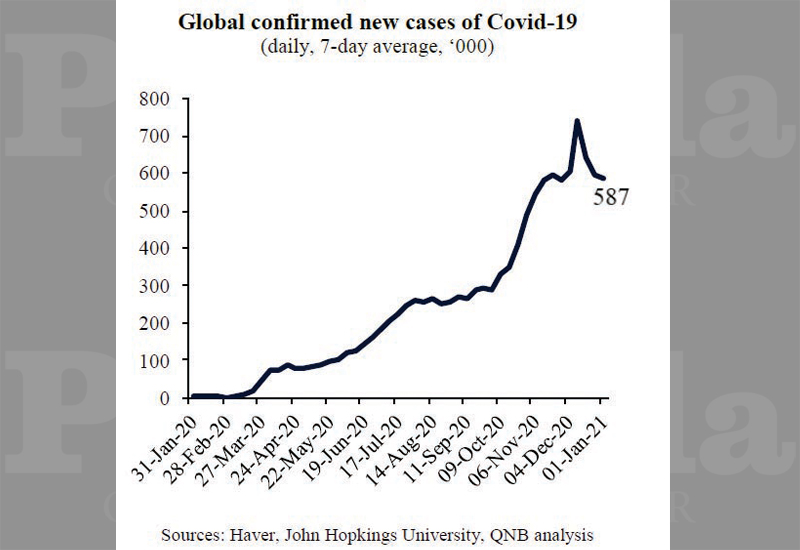
Doha: As we enter 2021, the rapid development of several effective vaccines against COVID-19 are offering the promise of a durable solution to the global pandemic. Fast vaccine distribution and mass immunisation programs are a necessary condition for a sustained global economic recovery this year. However, emergency mass immunisation plans are not a trivial matter, not even to mature advanced economies with vast resources, strong institutions and powerful administrative systems.
Initial efforts to acquire and distribute the vaccine are already proving more difficult than anticipated in countries with severe epidemics, such as in the US and Europe. A timely roll-out of the vaccines is key to prevent further infections and, critically, to dampen the chances of additional mutations on the virus.
Importantly, however, as new COVID-19 cases continue to be high globally, not only countries facing severe epidemics or a mismanagement of virus containment are having to re-impose more aggressive mitigation strategies (quarantines, curfews and lockdowns).
Two countries however stand out in the way how the pandemic has been managed. Japan and Sweden have implemented different mitigation strategies which produced an initially successful containment of the virus over the summer. However, a rise in new cases started to emerge in recent weeks.
In Japan, one of the first countries to experience COVID-19 cases outside China, the government was effective in rapidly bringing down new cases through containment and prevention policies. This included mask wearing, mass testing, and success in isolating infected patients and enforcing social distancing measures. But even after several months with a very low level of new COVID-19 cases, Japan is now facing a new wave of cases, a number of which have been linked to a new, potentially more infectious variant. An emergency declaration is at the time of writing being considered for Tokyo, Chiba, Saitama and Kanagawa.
In Sweden, after a big surge of new cases in April-May, the government was able to control the virus through a more heterodox strategy. Instead of applying horizontal social distancing measures (government mandated lockdowns of entire populations and regions), it applied a less stringent vertical social distancing strategy, with voluntary restrictions and the isolation of the most vulnerable and the infected patients. The idea was partially to build natural “herd immunity” in the younger and healthier population. But a recent spike in new cases is creating a U-turn in policies, as the government is starting to adopt more restrictive measures.
All in all, COVID-19 is still far from being under control. Even in advanced economies that initially succeded in controlling the virus, such as Japan and Sweden, new cases are surging. Although the numbers of cases are growing significantly in Japan and Sweden, the overall number is still low in comparison with countries with more severe epidemics. Similarly, countries that brought the virus under control should not be complacent, as preventive measures should continue to be in place until mass immunisation is reached. A failure in virus containment may produce virus mutations that are more difficult to manage. More contagious strains of COVID-19, such as the one that is dominating new cases in the UK and spreading in South Africa, can produce more acute epidemics and provide a bigger base for further mutations.