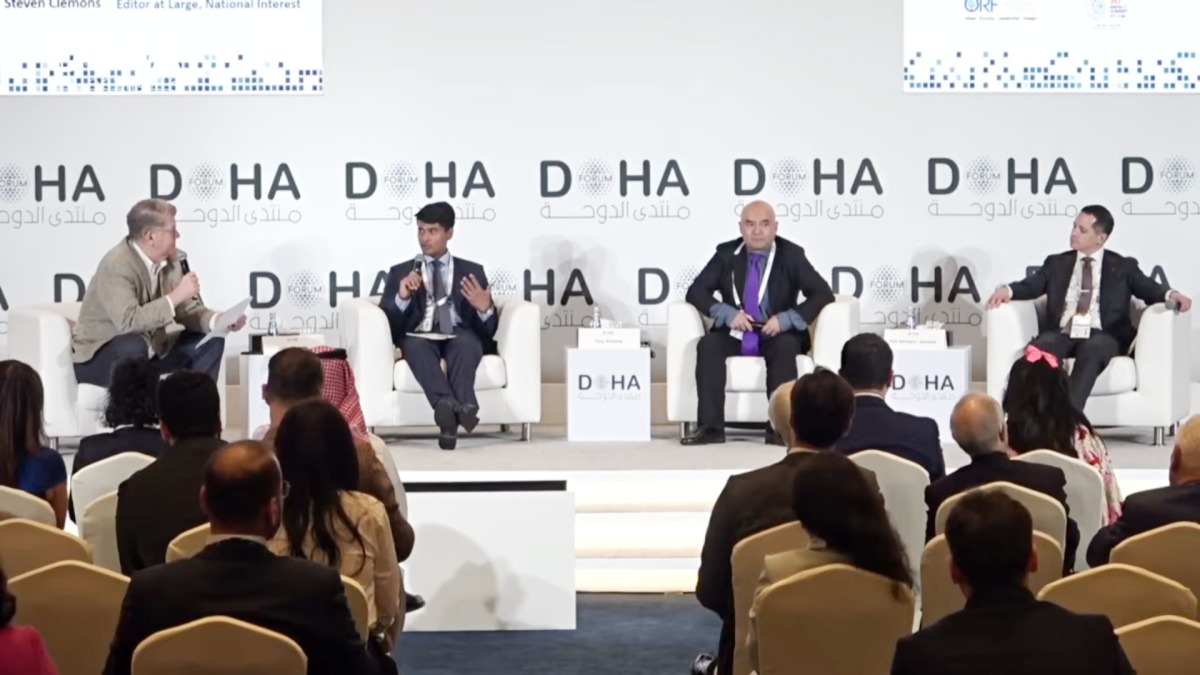
Experts exchanging ideas during the panel discussion, yesterday.
Doha, Qatar: Artificial intelligence is rapidly becoming a defining feature of economic competitiveness and geopolitical power. For resource-rich nations looking beyond hydrocarbons, AI offers potential pathways to build new industries, attract investment, and leapfrog traditional development models.
On the sidelines of Doha Forum, yesterday a panel session entitled ‘Competing for the Future: AI’s Role in Economic Transformation and Global Power’ was held which explored whether the technology can enable genuine economic diversification, how it is reshaping global power dynamics, and what it will take to ensure AI’s advantages are broadly shared rather than concentrated among a few dominant players.
Addressing the session, Siddharth Yadav, Senior Fellow at Observer Research Foundation noted that discussions on AI and speculations about the capabilities of AI have been part and parcel of science fiction narratives for over a century. And theoretical sort of innovations in AI research have been going on for decades up to now.
But the sort of speed and scale with which we have seen the expansion of AI capabilities since the release of ChatGPT in December 2023 caught everyone by surprise. No one was expecting for such a rapid development and innovation speed of artificial intelligence tools.
He said, ever since the release of ChatGPT, the scale with which we have seen adoption of ChatGPT and other AI tools grow, sort of made it very clear that all the regulators and policymakers around the world need to regulate this technology very quickly.
“There is no way; one can anticipate what the possible implications of the technology are going to be. So when you’re planning regulation, trying to develop a governance framework, it has to be iterative. It has to be step by step, because you cannot plan the whole scenario at the outset,” he added.
For his part, Prof. Michael C Horowitz, Director of Perry World House and Richard Perry Professor, University of Pennsylvania explained the geostrategic significance of the AI race. He said, “I think about AI as a general purpose technology. It’s akin to electricity or the combustion engine or the printing press, and that means it’s going to be everywhere and matter for everything.
He added, “I think that this is more of a generational kind of competition but the stakes are about the future of the global economy and who will have leadership in the global economy, which means that this is really an adoption question in some ways as much as anything else.”
Meanwhile Tang Xiaoyang, Chair and Professor, Tsinghua University Department of International Relations said, the major thing is actually we need to distinguish between automation and autonomy. Actually, AI is a part of technology and a tool. “It had to follow this rules of automation, it’s just our automation to the next level but autonomy, that’s about what people talk about self-worth, and self-consciousness. That’s a totally different way of thinking. So autonomy is to give it laws, while automation is just to follow laws.
Speaking to The Peninsula on the sidelines of the session, Yadav noted “It’s my first time at the Doha Forum, and I am very impressed with the caliber of people they have been able to bring in. It’s not easy to create and curate an event with such different points of views, but I think they have done a fantastic job. ”
Replying to query on the challenges of AI, Yadav said, the challenges of AI are very persistent. It is a very new and dynamic technology. So the problems that come with such a technology are also going to be very different.
There are countries that try to regulate too much or too little and then there are countries that are trying to find the balance. The countries in the global south like India, the UAE, and Qatar are all trying to figure out how to go about governing and developing this technology responsibly. And the problem is “we don’t even know what the problems are going to be because the technology is so transformative. We are talking about something that can make its own decisions, impact people on an individual, enterprise or a national level,” he said.