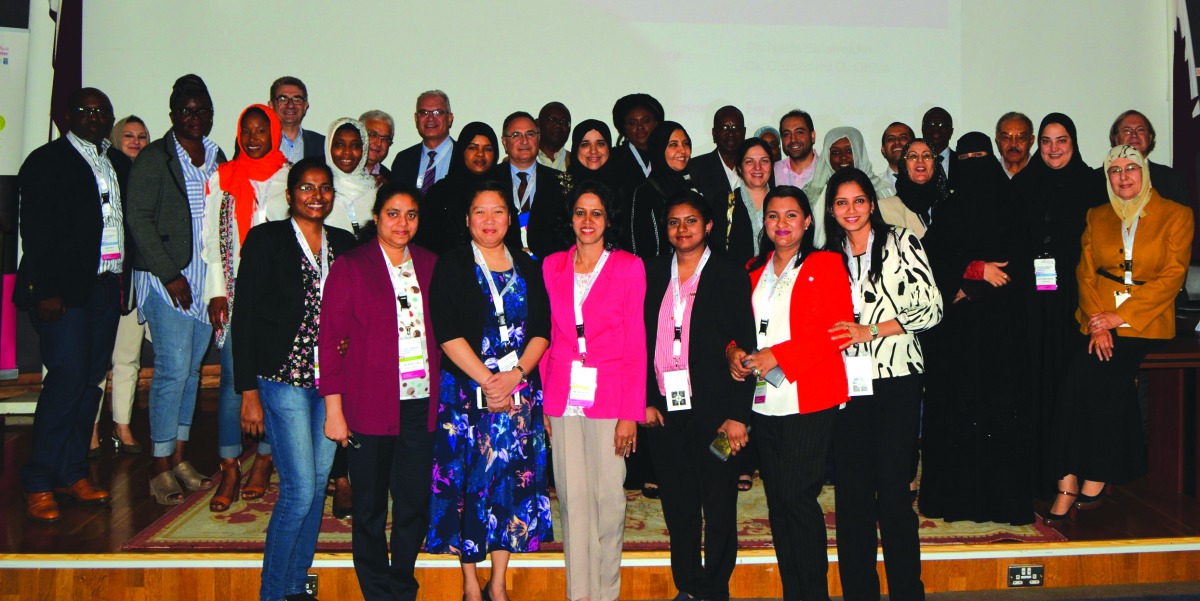
The WWRC’s Feto-Maternal Medicine Unit team and some of the delegates at the First Qatar Challenges of Cesarean Births Symposium.
DOHA: A cesarean section is recommended in around 30 percent of deliveries across Hamad Medical Corporation (HMC)’s maternity hospitals.
Though most women will not require a C-section, it is important that expectant mothers prepare themselves, particularly emotionally, should their doctor advise that a surgical birth is necessary, said Dr Najat Khenyab, Senior Consultant and Head of the Feto-Maternal Medicine Unit at the Obstetrics and Gynecology Department at HMC’s Women’s Wellness and Research Center (WWRC).
“Sometimes there are medical reasons that make a C-section the best option for a woman and her baby. In many cases, we know in advance that a C-section will be required and the woman is able to prepare herself.
However, there are times when an emergency C-section is necessary and knowing what to expect can help make the situation less stressful for a woman and her family,” she said.
“A cesarean, or C-section, is the surgical delivery of a baby and involves making incisions in the mother’s abdominal wall and uterus. While many C-sections are planned in advance due to a woman developing pregnancy complications or having had a previous C-section,” Dr Khenyab said adding in some cases it doesn’t become obvious until labor is well underway that a cesarean is required.
“It is important to note that a C-section is a major surgery and is not necessary, nor recommended, in most pregnancies. There are a number of reasons why a woman may need an emergency C-section, including fetal or maternal distress, maternal hemorrhage, placental abruption, or a prolapsed umbilical cord, but this is not an elective procedure. Being advised she will require a C-section can be a very emotional and traumatic event for many women so it is important that pregnant women and their families are prepared in the event a C-section is recommended,” said Dr Khenyab
A cesarean is generally a safe procedure, but like any type of surgery, it carries a certain amount of risk. Dr Sawsan Al Obaidly, Consultant Maternal-Fetal Medicine at the Obstetrics and Gynecology Department, at WWRC says possible complications of a cesarean delivery include blood clots, excessive bleeding, and the potential for damage to internal organs.
“Major complications relating to cesarean delivery are wound infections, post-partum hemorrhage, blood clots, reaction to anesthesia, injury to pelvic organs, and increased risks during future pregnancies,” she said.
Overcoming these pregnancy challenges and labor conditions and related issues were highlights of the ‘First Qatar Challenges of Cesarean Births Symposium,’ which was recently hosted by the Feto-Maternal Medicine Unit.