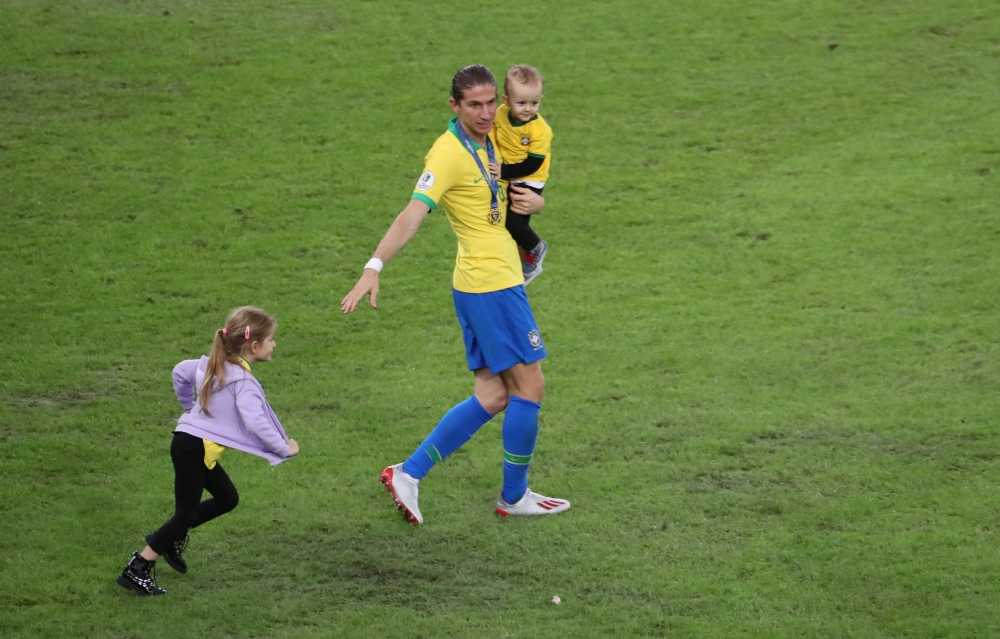
Brazil's Filipe Luis celebrates winning the Copa America. Reuters/Sergio Moraes
Brazil’s soccer team won its ninth Copa America title on Sunday, wearing the squad’s legendary yellow and green jersey. But in the nation’s bitterly polarized political environment, some fans felt unable to wear the colors.
The team’s Nike Inc.-designed jersey has long been worn with pride by ordinary Brazilians. But over the past few years it’s been adopted by the political forces that lifted President Jair Bolsonaro to power. That leaves diehard soccer fans from the opposite end of the political spectrum, like Euclides Bitelo, reluctant to sport the shirt he used to wear on a weekly basis.
"I feel embarrassed to use the national team’s jersey,” Bitelo, who runs a bakery in southern Brazil and voted against Bolsonaro, said. "It seems like a nationalist tactic to appropriate the symbol of Brazilian soccer, as if they were the country’s sole representatives.”
Brazil beat Peru 3-1 in Rio de Janeiro for their first Copa title since 2007. But it was at the same Maracana stadium in the 1950 World Cup final that Brazil suffered one of its most devastating defeats; in the wake of that national tragedy, the yellow jersey known as the Amarelinha was created.
Click here to see the progression of Brazil’s Nike-designed soccer jersey from 1996 to 2018.
The Maracana was also where Brazil racked up its last big championship, defeating Spain in the 2013 Confederations Cup. Protests against government spending on stadiums didn’t prevent the World Cup the next year. Then-President Dilma Rousseff boasted, "Brazil is dressed up in green and yellow; the idea there wouldn’t be a Cup has been buried.”
Unrest continued, however, and protesters began wearing team colors as they demanded Rousseff’s ouster and an end to corruption. Defenders of the left-wing leader tended to dress in red. The conservative movement kept using the uniform at rallies for Bolsonaro, who surfed the wave of public anger over graft and anti-Workers’ Party sentiment to victory. They still wear the Amarelinha at pro-government demonstrations; those wearing red have faced attacks.
In office, there was hope that Bolsonaro might work to reduce polarization, but he’s reinforced it, according to Rafael Cortez, partner at political consultancy Tendencias. Bolsonaro has seen his support falling; his approval rating after 100 days was lower than any other leader since the country’s return to democracy, according to polling company Datafolha. His support base, however, remains passionate and vocal.
"Part of the electorate that gravitates toward the center-right and has a link to the yellow and green aesthetic isn’t necessarily Bolsonarist; it’s anti-Workers’ Party,” Cortez said. "To recover and preserve popularity, or prevent a bigger fall, Bolsonaro is drawing closer to the aesthetic connected to the conservative movement, making his presence felt at the games.”
Bolsonaro attended the tournament opener and the team’s July 2 match against arch-rival Argentina alongside Economy Minister Paulo Guedes. He took a halftime stroll on the sideline and waved the Brazilian flag for adoring fans. Argentina’s soccer federation complained to the league that he violated rules prohibiting political acts.
On Sunday, he celebrated with a simple tweet.
Bolsonaro is far from the first Brazilian president -- on either side of the spectrum -- to bask in reflected soccer glory. Still, some found his presence at the game jarring.
"How do you manage to root for the team after seeing Bolsonaro and Guedes in the crowd?” Laura Carvalho, a left-leaning University of Sao Paulo economics professor, wrote on Twitter. Bolsonaro supporters responded with vitriol, telling her she should cheer for Venezuela.
When Bolsonaro appeared on screen, much of the stadium erupted with boos. But that isn’t proof of rejection, said sportswriter Juca Kfouri, as Brazilians traditionally boo their leaders. In the Maracana, it’s said fans will even boo a minute of silence.
Fans at the stadium were hardly representative of the electorate at large. With tickets for the game starting at 190 reais ($50) -- or a fifth of the monthly minimum wage -- those in attendance were middle- and upper-class, groups largely sympathetic to the president.
At a bar across town, Laura Macedo, a 32-year-old labor lawyer, said she’ll cheer for the team. Her Brazil shirt will remain home, in the back of a drawer. Even on game day, she doesn’t want to risk being mistaken for supporting Bolsonaro or right-wing politics.
"If someday the Brazil shirt ceases to be the symbol of those movements, maybe I’ll use it again,” said Macedo. "I’d like to wear it, but I won’t.”