

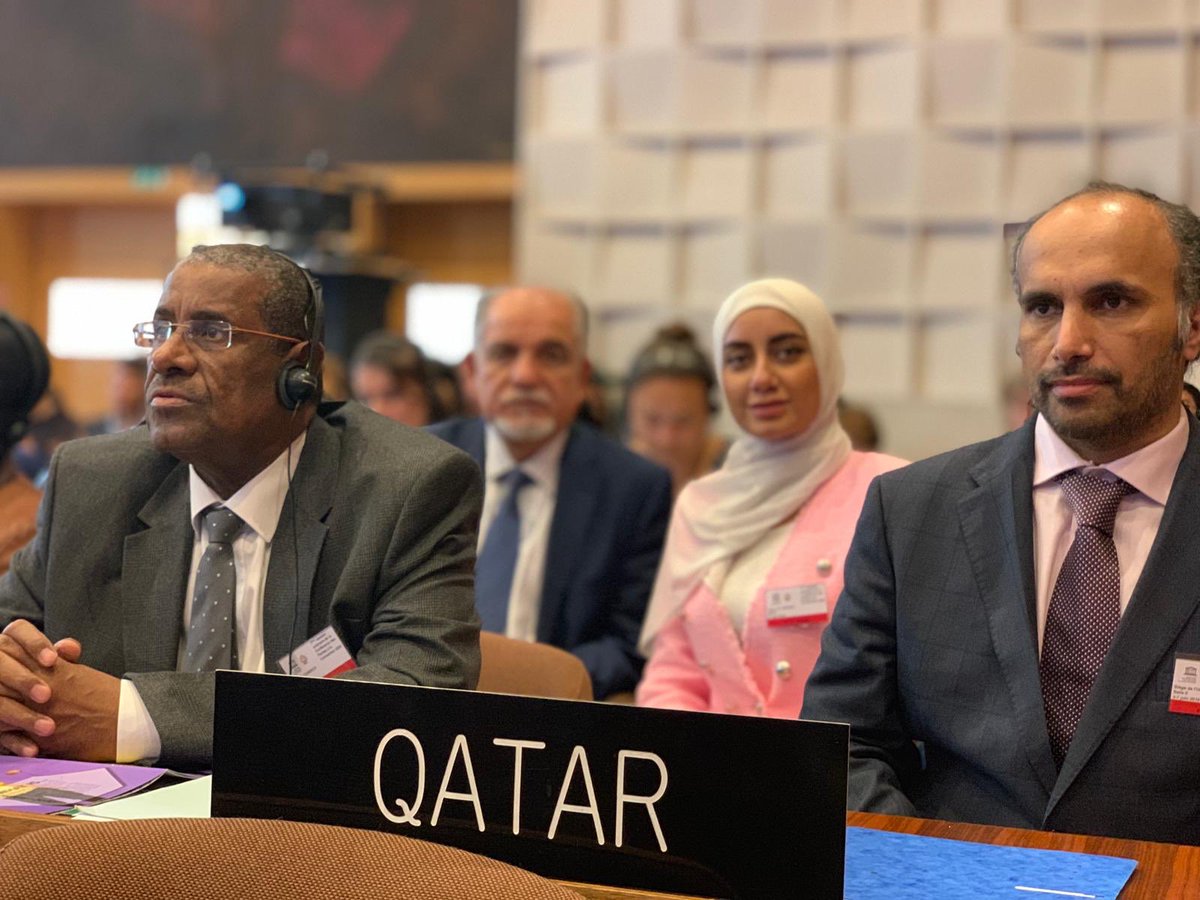
Paris: The Ministry of Culture and Sports is participating in the Seventh Ordinary Session of the Conference of Parties to the Convention on the Protection and Promotion of the Diversity of Cultural Expressions, currently held at the headquarters of the United Nations Educational, Scientific and Cultural Organization (Unesco) in Paris with the participation of officials and experts from around the world.
In a paper presented at the conference, the Ministry emphasised the importance of cultural diversity and its support as an essential dimension of intercultural dialogue and an important factor for sustainable development, and that Cultural diversity promotes human rights and belonging to national identity along with full respect for other cultural identities coexisting in a single society.
The paper presented the efforts of the State of Qatar in supporting cultural events that highlight cultural diversity and enhance it among the expatriate communities within Qatar, as well as its support for regional and international cooperation and communication, which reflects the civilised image of the State.
The paper also touched on Qatari projects that support cultural rapprochement, including the Cultural Years Project; the Qatar Philharmonic Orchestra, which is composed of 101 musicians from the region; the World Cultural House Project; the Francophone Cultural Days in the State, the establishment of community radio stations in Qatar and the Cultural Village Festival at Qatar University.
It pointed that the State of Qatar, in its adoption of cultural diversity, is relying on the Qatar National Vision 2030, which serves as a roadmap for sustainable development, and seeks to intensify and promote cultural exchange with other peoples, in addition to sponsoring and supporting the dialogue of civilizations and coexistence between different religions and cultures.
The paper referred to some projects that serve Qatar National Vision 2030, including the Doha International Center for Interfaith Dialogue, the Qatar Committee for the Alliance of Civilizations, the Qatar Global Award for Dialogue among Civilizations and Wijdan (Conscience) Cultural Centre.
The paper also offered examples of cultural initiatives in Qatar including the Doha Award for Drama Writing; the cultural centers of the Ministry of Culture and Sports, the Sheikh Hamad Award for Translation and International Understanding, the Ministry of Culture and Sports’ translation project, the Cultural Diversity Festival in Katara; Qatar Foundation’s project to include heritage in educational curricula and the project to include the values of cultural diversity in school curricula.
It also reviewed a number of important dates related promoting cultural diversity in the State of Qatar, including the State of Qatar accession to the Convention on the protection and promotion of cultural expressions in 2009; Naming Doha as the capital of Arab culture in 2010; the establishment of the Forum of Arab and international relations Qatar 2011and cultural years between Qatar and Japan 2012, UK 2013, Brazil 2014, Turkey 2015, China 2016, Germany 2017, Russia 2018 and India 2019 in addition to the Doha Capital if Islamic Youth 2019. The Ministry of Culture and Sports was represented at the meeting by Director of Culture and Arts Department Hamad Mohammed Al Zakeeba, Adviser at the Ministry of Culture Hamad Hamdan Al Mohannadi, and researcher at the Ministry Reem Mohammed Al Balushi.
Adopted in 2005, the Convention on the Protection and Promotion of the Diversity of Cultural Expressions main objective is to strengthen creation, production, distribution/dissemination, access and enjoyment of cultural expressions transmitted by cultural activities, goods and services, with a strong focus on developing countries. The Convention has 146 parties; 145 countries and the European Union.
They meet every two years at Unesco headquarters to study the Convention and its implications and identify future actions.





