Director of the Crisis and Support Centre at the French Ministry for Europe and Foreign Affairs, Philippe Lalliot
Doha, Qatar: Director of the Crisis and Support Centre at the French Ministry for Europe and Foreign Affairs, Philippe Lalliot praised Qatar’s growing global leadership in humanitarian action and mediation, calling its role “distinctive, influential, and irrepressible” during an interview with The Peninsula, yesterday.
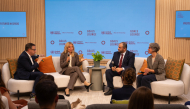
Lalliot, in Qatar for the Doha Forum 2025, said the theme ‘Justice in Action: Beyond Promises to Progress,’ highlights the urgent need for fairness, equality, and accountability which core principles for crisis response and international cooperation.
“Justice is not optional or negotiable,” he said. “We must stand firm on the values we believe in: respect for international law, humanitarian law, multilateralism, solidarity and generosity. These principles must translate into concrete measures, not just declarations.” He noted that discussions on the first day of the forum reflected a growing consensus for action-oriented humanitarian work.
Lalliot confirmed that Qatar and France are already engaged in several joint humanitarian initiatives particularly in Lebanon, Gaza and Afghanistan, but highlighted that both sides are now exploring a shift toward long-term, structural cooperation.
“We do a lot already, but I’m sure we can do more,” he said adding that several meetings are scheduled with Qatari officials during his stay in Qatar.
Among the new areas under discussion Lalliot said that Qatar and France are considering creating a annual fund, equally financed, to support global crisis response.
“It’s a more sophisticated approach, we put the money first, and then jointly decide where it should go,” Lalliot he said.
France is also evaluating locations in the Gulf for a new emergency-response stockpile, to ensure faster deployment to crises in the Middle East, East Africa and beyond.
“We want to hear Qatar’s views,” he said. “These stocks are expensive but essential. They save time and time saves lives.” Lalliot said the Centre is currently focused on several “structural crises” including Gaza, Syria, Lebanon, Ukraine and Sudan.
“These crises are very close to both of us, Qatar from the south, Europe from the north,” he said. “They shape our security and how we see the world.” He also warned that several devastating crises receive far less global attention including in Haiti, Myanmar and Afghanistan.
“Unfortunately, compared to two or three years ago, we now have more crises, more violence, more brutality,” he said. “The list has no end, which is a shame and a pity.” Asked how France is ensuring aid reaches the most vulnerable, Lalliot emphasised the need for broad partnerships.
“We work with UN agencies, NGOs, strong state partners like Qatar, and also private companies and foundations,” he said. He credited France’s network of 170 embassies and consulates for its ability to operate close to crisis zones.
“Without these people in the field we could do absolutely nothing,” he said. “Humanitarian response is an ecosystem, and cohesion is essential, even if difficult.” To highlight Qatar’s expanding global role, Lalliot emphasisied the country’s growing commitment to humanitarian assistance and conflict resolution.
“Qatar has become one of the biggest donors in the world,” he said. “Qatar is not only a major donor. It is an influential humanitarian actor and one of the most respected mediators,” he said. “What is impressive is how Qatar moved from mediating in its own region to mediating in the Great Lakes, a completely different context and then even in Colombia.” He described Qatar’s global role as a “distinctive footprint” and “a very impressive scorecard on complex, painful issues.” “In a nutshell,” he said, “Qatar’s contribution to stability and peace in the world is exceptional. We all hope Qatar continues assuming these responsibilities.”