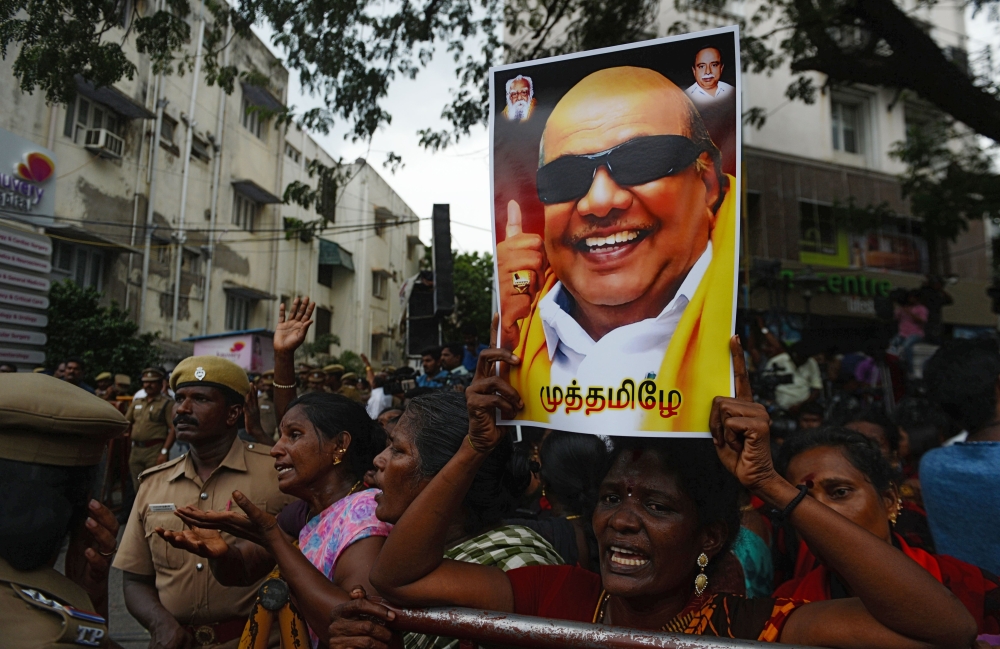
A Dravida Munnetra Kazhagam (DMK) party supporter holds a portrait of party president M. Karunanidhi (R) in front of hospital where he died, in Chennai on August 7, 2018. (AFP / ARUN SANKAR)
Chennai: Muthuvel Karunanidhi, a popular scriptwriter-turned-politician in the southern Indian state of Tamil Nadu, has died after a prolonged illness. He was 94.
Karunanidhi, a charismatic self-styled champion of the poor, had been in intensive care since July 28 in Chennai, the capital of Tamil Nadu state.
A big crowd had been thronging the streets outside the hospital since his hospitalisation but it swelled to some 6,000 Tuesday, an AFP photographer estimated, after doctors said he had suffered a "significant decline".
Prakash Duria, a doctor at the Kauvery Hospital, later confirmed to AFP that he had died.
Prime Minister Narendra Modi immediately tweeted condolences to Karunanidhi's family, saying "India and particularly Tamil Nadu will miss him immensely".
"Deeply saddened by the passing away of Kalaignar Karunanidhi," Modi said.
"He was one of the senior most leaders of India. We have lost a deep-rooted mass leader, prolific thinker, accomplished writer and a stalwart whose life was devoted to the welfare of the poor and the marginalised," he added.
Supporters beat their chests and chanted the leader's name as hundreds of police struggled to contain the surging crowds pressing against barricades.
Local channels reported that the numbers of curious onlookers and his party supporters increased around the hospital after news of his death.
The Press Trust of India news agency said a security alert had been sounded across the state, bearing in mind the outbreaks of violence in the past over the deaths of popular figures.
Karunanidhi was chief minister of Tamil Nadu five times and successfully contested 12 state elections, building legions of supporters on the way.
His popularity had not waned even though he handed over the reins of his Dravida Munnetra Kazhagam (DMK) party to his son M.K. Stalin.
Karunanidhi, a school dropout, became involved in politics at a young age, spearheading the DMK which was allied for many years to the Gandhi dynasty's Congress party.
Affectionately called "Kalaignar" or scholar, he wrote reams of poems, lyrics and books and was a prolific screenwriter for the Tamil film industry.
His popularity rivalled that of J. Jayalalithaa, another powerful leader from Tamil Nadu whose death sparked a huge outpouring of grief.
An estimated one million people lined the streets for Jayalalithaa's burial in 2016.
The deaths of Jayalalithaa and Karunanidhi leave a big political vacuum in one of India's most industrialised and prosperous southern states only months before key national election early next year.
Karunanidhi, who had been in the public life for 80 long years and was one of the two poles in the state, leaves a void in the Dravidian politics and triggering nationwide mourning for an essentially regional leader.
He had enticed the Tamil Nadu state all his political career through powerful oratory and script writing that changed the course of politics and the way Tamil cinema was made and helped the DMK's growth. He was just 14 when be became a student activist.
Men and women, who had been praying for their leader's recovery, wailed outside the hospital as news of his death broke. By then, Chennai was already tense, with residents stocking essentials like milk and vegetables anticipating a state-wide shutdown.
The mortal remains of the leader will be taken to his home in Gopalapuram here and then to Rajaji Hall for people to pay their last respects. The Tamil Nadu government announced a week-long mourning.
A DMK leader said Karunanidhi's mortal remains will be laid to rest on Wednesday.
Prime Minister Narendra Modi, a host of Chief Ministers, Congress President Rahul Gandhi and several others from across the country are expected to fly to Chennai on Wednesday.
Karunanidhi leaves two wives -- Dayalu and Rajathi, three sons including DMK Working President M.K. Stalin and former Union Minister M.K. Alagiri, daughter Kanimozhi (MP) and several grandchildren.
The DMK patriarch, who had faded from public life for nearly two years, had been in and out of hospital as he aged. His hospitalisation early on July 28 followed a sudden dip in blood pressure.
Occasionally, the hospital claimed improvement in his condition. But on Monday it said there has been a decline in his health and that maintaining his vital organ functions continued to remain a challenge. It also said that his response to medical interventions over the next 24 hours would determine the prognosis.
Even on Tuesday evening, the hospital came out with a bulletin saying there had been a significant decline in the condition of Karunanidhi "over the last few hours". It said: "His condition is extremely critical and unstable."
Even before the grim bulletins were issued, Karunanidhi's family and the state appeared to be preparing for the inevitable.
Ahead of his death, the Tamil Nadu Police mobilized all its personnel across the state.
Karunanidhi, who only 10 days ago completed 49 years as DMK chief, led his party through various ups and downs against charismatic rivals MG Ramachandran, who had banished him to the opposition ranks till his own death in 1987, and J. Jayalalithaa, who died in 2016.
From 1967, when the DMK ousted the Congress for ever from power in the state, Tamil Nadu has been ruled either by the DMK or AIADMK.
Succeeding his mentor Annadurai in 1969 as chief minister, Karunanidhi maintained a strong hold over the party and government.
Though he didn't aspire for politics beyond Tamil Nadu, the multi-faceted leader played key roles in national politics starting from when he aligned with Indira Gandhi in 1969 on issues like bank nationalisation and later in the formation of coalition governments under VP Singh, HD Deve Gowda, Atal Bihari Vajpayee and Manmohan Singh.
Once the ethnic conflict erupted in Sri Lanka in 1983, Karunanidhi became a champion of the Tamil cause and, later, the Tamil Tigers, often putting pressure on New Delhi to change its course vis-a-vis Colombo. But the LTTE's assassination of former Prime Minister Rajiv Gandhi in 1991 almost wiped out the DMK, leaving him as the sole winner in Assembly elections.
It was one of the 13 Assembly elections he never lost and which helped him rule Tamil Nadu five times.
As Chief Minister, he had pioneered several welfare schemes and introduced freebies in the country's politics. An avowed atheist, Karunanidhi was known for his trademark dark glasses as well as a yellow stole. The latter, critics felt, betrayed his hidden superstitious feelings.
Karunanidhi dominated the Tamil-language movie industry as a screenwriter beginning in the 1950s, and later the political scene for nearly five decades. He became the state's chief minister, the top elected official in 1969 and held that position five times for a total of 19 years.
Karunanidhi stopped making public appearances two years ago as his health deteriorated.
Meanwhile, a dispute erupted over the burial site for Karunanidhi with the state government, run by a rival party, rejecting his party's demand that he be laid to rest on Marina beach in Chennai, the state capital, next to a memorial of his mentor and the party founder, C. N. Annadurai. The burial is scheduled for Wednesday.
Stalin accompanied by Alagiri and Kanimozhi and top leaders of the party met Chief Minister E Palaniswami and pressed for Karunanidhi's body to be interred on the Marina Beach near DMK stalwart CN Annadurai's mausoleum. But the government declined the request.
The state government, run by the All India Dravida Munnetra Kazhagam, in a statement said it was unable to allot space at Marina beach owing to some legal disputes pending a court settlement. It offered a two-acre (less than a hectare) site elsewhere in the city.
The Press Trust of India news agency said the state government appeared to be reluctant to allot space for Karunanidhi's burial at the Marina beach as he was not a serving top elected official.
Karunanidhi's DMK party moved a petition before the chief justice of the state High Court who is expected to hear both sides later Tuesday.
He is the second key political figure to die in Tamil Nadu state in the past two years after Jayaram Jayalalithaa of the Anna Dravida Munnetra Kazhagam party, creating a huge political vacuum.
Cinema has always influenced Tamil politics by turning actors into popular politicians. C.N. Annadurai and Karunanidhi were both scriptwriters who went on to become chief ministers. M.G. Ramachandran, a top actor-turned-politician, also had a strong screen presence and following and ruled the state for nearly 10 years as its top elected official.
From his school days, Karunanidhi showed interest in drama, poetry and literature. He began his career as a screenwriter in the Tamil film industry at the age of 20. His first film, Rajakumaari, gained him recognition and popularity.
Karunanidhi penned screenplays and dialogues for more than 50 movies. He also wrote the stories for some of them, such as Marudanattu Ilavarasi, 1950, Mandiri Kumari, 1950, Tirumbipar, 1953 and Arasilangkumari, 1961.
He became a powerful political figure using his wit and oratorical skills after joining politics at age 33 and winning a state Legislature seat in 1957. He won 13 state elections as a lawmaker.
He had three wives, one of whom has died. He is also survived by four sons and two daughters, according to the Press Trust of India news agency.
Karunanidhi's second son, Stalin, is his chosen political heir. A daughter, Kanimozhi, is a lawmaker in the Indian Parliament.