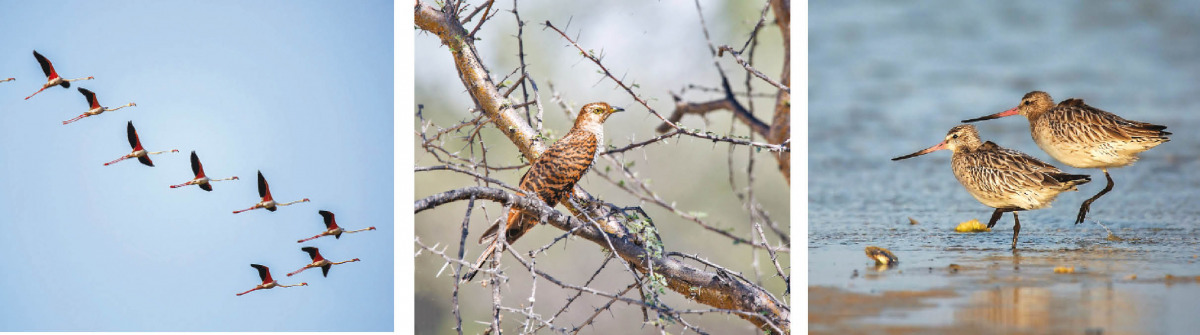
From Left: Flamingos, cuckoo and white tailed Godwit sighted in various parts of the country. Pic: Vishnu Gopal
With winter round the corner, hundreds of migratory birds have started flying in to the country. More birds are expected to come along by the month end, according to experts.
Winter in the Middle East is the most attractive season for birds migrating from the extreme cold weather in Europe. Thousands of migratory birds fly in to the comparatively warmer Arabian Gulf seeking food and comfort.
Migration is one of the most extraordinary events in the natural world. Every year thousands of species migrate vast distances, to move between breeding and non-breeding ranges.
“Of some 315 species of birds found in Qatar, a majority of 257 are migratory and winter visitors. While some spend the winter here, many others take a brief stopover in Qatar while on transit to Africa,” said C Thajudeen, a keen birdwatcher.
The various nestling areas within Qatar have been receiving huge number of birds. Several varieties of birds, including Greater flamingo, Northern lapwing, European roller, White-throated robin, Eurasian hobby,Eastern Imperial Eagle, Greater Spotted Eagle,Marsh harrier, Pallid Harrier,Montagu's harrier, Black-winged Pratincole, Eurasian Curlew, Black-tailed Godwit, Semi-collared Flycatcher, Eastern Cinereous Bunting and Pacific golden plover, among the others can be sighted in various parts of the country.
Though each year, new species of birds are being recorded here, there is a decline in the populations of various species, according to experts.
More than half of migratory bird species travelling the world’s main flyways have suffered serious population declines in the past 30 years. Migratory birds fly through various geographical places during its annual cycle for food, rest and breeding. So even if most of their breeding grounds are protected, threats at one place can affect the entire population.
“Qatar is a major stop-over or breeding space for a number of species that are gravely endangered. We need to have effective conservation methods to protect these species. Otherwise, Qatar's ecology will lose these beautiful guests permanently,” said the birdwatcher.
Sociable Lapwing, a bird classified as critically endangered species by BirdLife International has not been sighted in Qatar for the last three years.
Houbara Bustard, another threatened species also visits Qatar every winter. Houbara, the most popular bird of prey, is a resident of colder Central Asia and migrates to spend the winter in a relatively warm environment in South Asia. Extensive hunting is endangering the species globally.
“Many birds are forced to move away from their nestling spots here with illegal hunting and poaching. There is hardly any control over hunting and so many critically endangered species we had seen here before are no longer sighted,” said another expert.
Added to this, climate change is also taking its toll on the birds by affecting the breeding period and thus reducing their population.
There is no proper survey or monitoring of these guests here. Though expansion of green areas in Qatar attracts more birds, they are forced to move to neighbouring countries due to illegal hunting.
“The traditional falconry is not a major threat as it's part of nature. However extensive shooting with gun is the culprit. Good hunters are good conservationists as they know which bird can be shot and which needs to be protected.
"Often birds are wounded but not recovered by hunters . For some birds which mate for life, hunting can devastate entire communities,” the expert said.
These winged guests can be found in large numbers in coastal areas offering a view for bird lovers.
"This is the best opportunity to bring our children closer to nature, diverting them from the virtual world to real world," a bird-lover said.