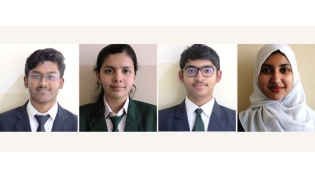
The media team of Sheikh Hamad Award for Translation and International Understanding (SHATIU) organised a webinar on “The Reality and Prospects of Translation in Bangladesh from and to Arabic” on Thursday in which several Bengali academics and translators participated.
Dr. Abu Jamal Muhammad Qutb Al-Islam Nomani, Professor of Arabic Language at Dhaka University, Bangladesh, spoke about Bangladesh’s experience in translating into Arabic and vice versa. He spoke about the rule of Bengal and introduction of Islam, the most famous and first translations in Bengali, including the translation of the Holy Quran several times due to the great demand and its popularity.
He also talked about the institutions that were interested in translation in Bangladesh, including the Islamic Foundation, which is one of the largest institutions concerned with translation, especially translation of Islamic books and others.
About individual efforts, Dr. Qutb said that individual efforts in translation were not less important than the efforts of institutions drawing attention to the scarcity of translation from Bengali to Arabic due to the lack of market and the high financial cost. Dr. Qutb Al Islam stressed on the importance of translation from Arabic to Bengali due to the keenness of people to understand Islam, and Arabic books translated into Bengali enjoy more popularity.
Dr. Mahfouz Al Rahman Muhammad Zaheer, Department of Arabic Language and Literature at the Islamic University of Kushtia, Bangladesh, talked about his own experience of translation from and to Bengali pointing out the prevalence of religious translation in Bangladesh because translators know religion, and they do not know other fields like philosophy, which prevented them from working in translation in other fields outside of religious sciences. He also spoke about his personal experience in translation as a translator specialised in translating religious, literary and historical books, but he translates some literature books at the request of some specialized institutions.
The third speaker, Dr. Abdullah Al Maamoun Abdul Latif, known as Al Azhari, and lecturer at the Department of Islamic Studies at Shantou Maryam University of Creative Technology Dhaka, spoke about areas of translation in the Bengali language (literature and humanities) and their nature. Dr. Abdullah said over 189 million people speak Bengali language globally.
He noted the interest of Bangladesh in translation and interpretation, and detailed history of translation in Bengali at ages including the middle ages (1200 - 1600) and after (1601 up to present).
He reviewed books that were translated into Bengali from Arabic in literature and religious sciences, translations and interpretations, poems, etc, and dealt with some translators of Bengali literature into Arabic such as the poems of Farooq Ahmed Khan, as he also emphasized, that the translations into Bengali are still few except for religious books.
For his part, Professor Abu Muhammad Salih, who is Professor at the Department of Daawa and Islamic Studies at the Islamic University in Kushtia, Bangladesh, spoke about the history of translation and the extent to which people read it. He emphasised that the translation into Bengali started with the translation of the Magus and Hindu scriptures, citing the paradox that these translations were at the request of Muslim sultans, which confirms their awareness of the importance of translation.
He pointed out that the motivation behind the translation from Arabic to Bengali is the religion adding that most of the individual translations from Arabic to Bengali faces weak institutional support under lack of educational institutions that train translators.
In response to a question by a follower of the symposium via Facebook, he answered that Youssef Zulekha’s book is the first to be translated from Arabic to Bengali in the year 1500 AD.
Dr. Imtenan Al Smadi praised the role of Professor Islam for his organization and coordination of the symposium, which is one of the first open seminars through the virtual system with translation.
In conclusion, Dr. Hanan Al Fayyad, media adviser to the award, spoke about the award’s goals, vision, the mechanism for distributing the annual financial value in addition to the award categories.
She stressed the importance of choosing the Korean language as one of the five languages in the achievement category for this season, and the award’s efforts to choose Persian as a second main language besides English, and the selection of five new languages in the achievement category, which are: Pashto, Bengali, Swedish, and Hausa in addition to Korean.
Dr. Al Fayyad asked interested people to look at the award’s website (www.hta.qa) to download the nomination forms and other benefits that enrich them about the nature of the award.