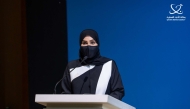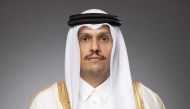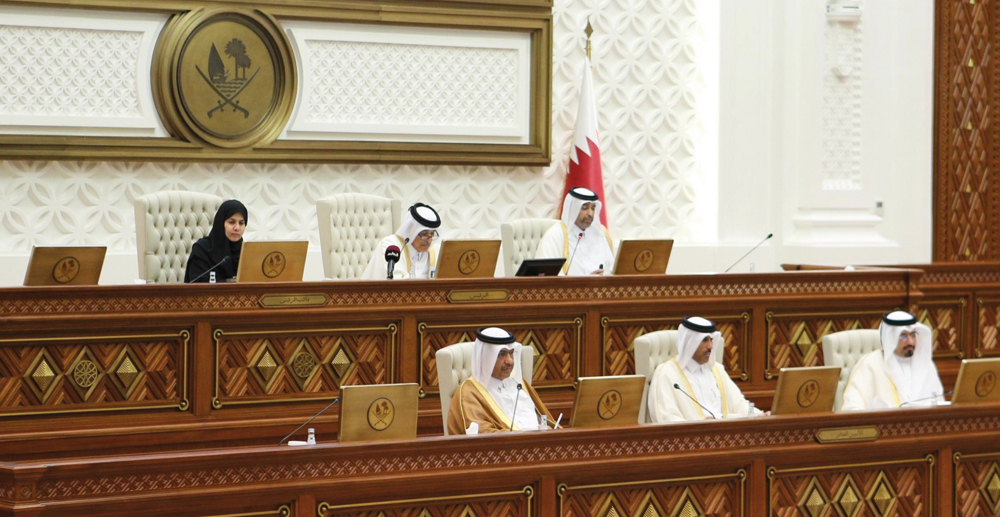
Shura Council Speaker H E Hassan bin Abdullah Al Ghanim (top centre); Deputy Speaker H E Dr. Hamda bint Hassan Al Sulaiti (left) and Minister of Environment and Climate Change H E Sheikh Dr. Faleh bin Nasser bin Ahmed bin Ali Al Thani during the meeting of the Council, yesterday.
Doha, Qatar: The Ministry of Environment and Climate Change (MoECC) is currently working on developing the Climate Change and Environmental Sustainability Strategy within the third National Development Strategy 2023-2030, which includes 5 areas of work, 29 strategic goals and 89 initiatives that include 99 strategic projects.
Minister of Environment and Climate Change H E Sheikh Dr. Faleh bin Nasser bin Ahmed bin Ali Al Thani said that the Ministry is also laying out and implementing the National Climate Change Action Plan which identified 300 actions to reduce the actual or anticipated effects of climate change.
The Shura Council yesterday held its ordinary weekly meeting under the chairmanship of Speaker of the Shura Council H E Hassan bin Abdullah Al Ghanim. In the presence of the Minister of Environment and Climate Change, the council discussed a number of issues related to the environment, plans and strategies for conserving the environment, along with challenges and projects in this field.
Speaker of the Shura Council praised the efforts being exerted by MoECC to implement the National Environment and Climate Change Strategy (QNE), pointing, in this context, to the close connection between Qatari people and their environment since ancient times, and their keenness to never damage it something which is rooted in their behaviours and habits they inherited from their ancestors.
Al Ghanim asserted that ancestors had consolidated sustainability concepts and environment conservation through their coexistence with terrestrial and marine environments.
Minister of Environment and Climate Change delivered a presentation that addressed a myriad of environmental issues, including the most prominent challenges facing this sector and the exerted efforts made to counter them, reviewing the QNE’s strategy as a core pillar for public policies to preserve environment for the current and future generations.
In this context, he said that Qatar, thanks to the vision of its wise leadership and with the efforts of the people of Qatar and its scientists and institutions, became a model in achieving the integrated development, preserving the environment and reducing influential carbon emissions in climate change, pointing out that the ministry has made great strides in achieving its national strategy goals.
Dr. Faleh pointed out that the ministry has achieved a number of projects and initiatives in its three sectors represented in environment affairs sector, protection and natural reserves affairs sector and climate change affairs sector.
He noted the country’s keenness to achieve the United Nation’s 17 Sustainable Development Goals (SDGs), whether in constructing the infrastructure, or building and establishing numerous eco-friendly smart cities and green buildings other than dependence on technology to overcome all challenges that faced that process.
During the presentation, the Minister addressed the efforts in safeguarding biodiversity in Qatar, emphasising MoECC’s keenness to propagate the culture of environment conservation through engaging the community.
He talked about MoECC’s efforts in modernizing the legislations, as well as response plans to environmental incidences and develop action mechanisms in all MoECC’s structures and departments through bolstering the quality of environmental data and striving to disseminate and modernize them.
The Minister stressed MoECC’s keenness to enforce the law and legislations, in pursuit of conserving the environment to monitor any potential infractions that could damage local environment or polluting it, in collaboration with relevant entities, pointing out that the Ministry has completed the digitization process for most services it offers to the public, in addition to leveraging technology in all its departments’ works in light of its priority to the national talents.
Responding to comments and questions raised by Their Excellencies members of the Shura Council, the minister underlined the country’s capability to handle various emergencies, such as radioactive contamination via an early warning network to be rigorously modernised followed by preemption through carrying out special courses to handle these cases.