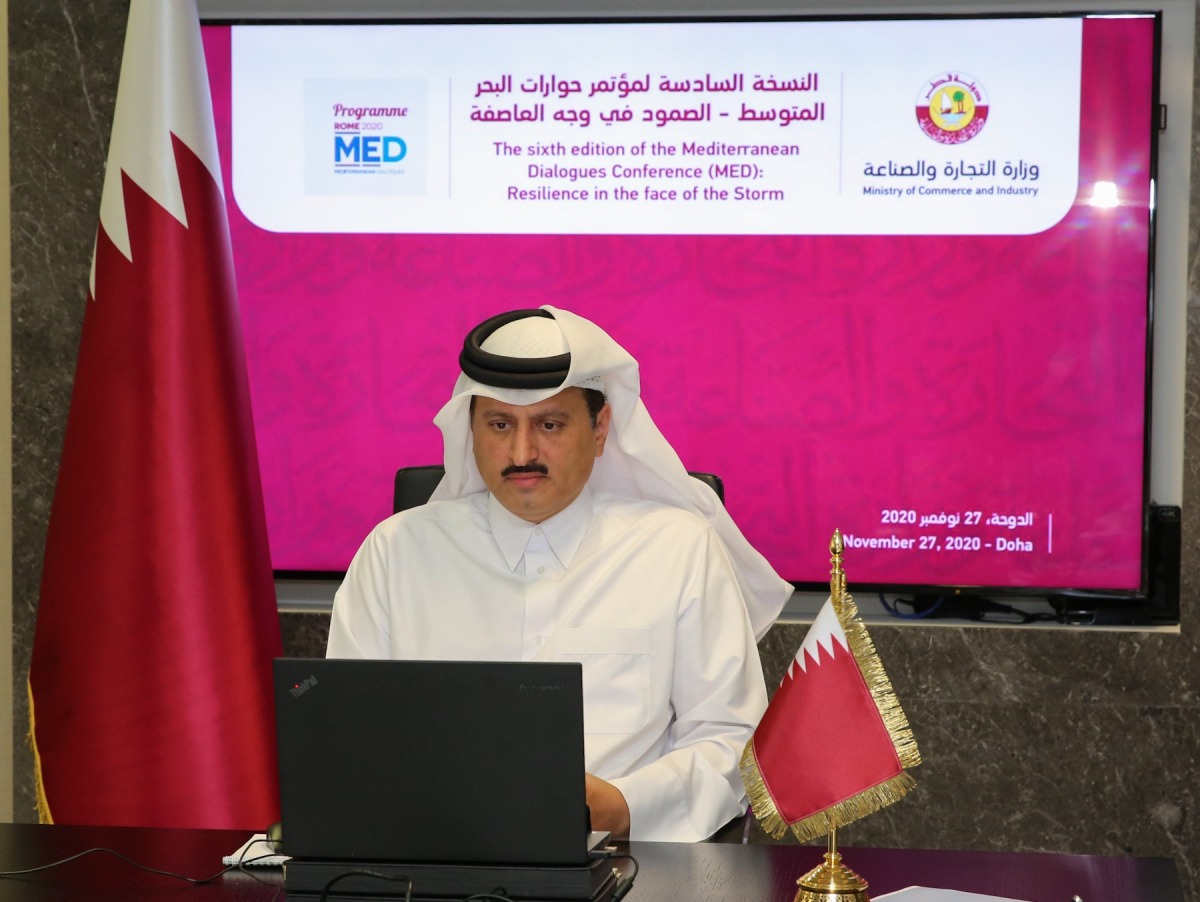
Undersecretary of the Ministry of Commerce and Industry (MoCI) H E Sultan bin Rashid Al Khater
Doha: Qatar has overcome all the challenges faced by global economies during the past years and has laid the foundations of a new phase leading to economic diversification, which has consolidated the country’s position as one of the most powerful and promising regional economies at the global level, Undersecretary of the Ministry of Commerce and Industry (MoCI) H E Sultan bin Rashid Al Khater has said.
In a comprehensive interview with the QNA, the Undersecretary reiterated that despite the economic repercussions of the COVID-19 pandemic, which has led to a decline in the growth of major global economies, the Qatari economy remains one of the region’s strongest economies and among the most promising economies at the global level, thanks to the Amir H H Sheikh Tamim bin Hamad Al Thani who charted a course to achieve the Qatar National Vision (QNV) 2030.
He explained that within the QNV, which aims to diversify the national economy and shift towards a new knowledge-based economy, Qatar has moved towards achieving a balance between the oil-based economy and the non-oil sectors.
According to the Undersecretary, Qatar’s GDP is forecast to rise from $161bn in 2021 to $201bn in 2025, and it is expected to reach $172bn in 2022, $181bn in 2023, and $191bn in 2024.
Qatar’s legislative and regulatory efforts have reinforced expectations for the growth of the country’s economy, Al Khater said, referring to the International Monetary Fund’s report that it expects the Qatari economy to witness a remarkable growth of about 3.2 percent in 2022, compared to about 2 percent in 2021, reflecting growth in all economic sectors, especially the investment sector.
He also referred to a report issued by the US-Qatar Business Council and said that foreign direct investment in Qatar has taken an upward trend thanks to the business environment, advanced infrastructure, and the balanced performance of the financial sector, which directly affected the country’s GDP.
Al Khater went on to highlight the role played by the MoCI in supporting national efforts aimed at promoting and expanding Qatari industries to achieve national self-sufficiency and supporting economic growth of the non-oil sectors.
The Undersecretary underlined that the Ministry encourages national industrial institutions to increase their productivity, in line with the Second National Development Strategy 2018-2022 and the Qatar National Manufacturing Strategy. The MoCI has also launched the joint framework contracts initiative in cooperation with the Ministry of Finance and Hamad Medical Corporation, which primarily aimed to cover the pharmaceutical and medical equipment sector, and its scope will be expanded to include other sectors in coordination with the concerned authorities, he added.
Work has also been done to raise the level of access to national goods and products to the largest number of sales outlets in the country by allocating about 50 percent of the exhibits to Qatari products, in addition to coordinating with over 30 governmental and semi-governmental agencies to motivate them to give priority to national products, and increase their purchases in this field, said Al Khater.
He also referred to the recent launch of the 1,000 Opportunities Initiative, which comprised of an electronic platform within the Single Window Platform, which is expected to provide significant investment and economic opportunities that would benefit the industrial sector, which has seen remarkable development during the past years.
The Undersecretary also highlighted other public-private initiatives in Qatar to support the non-oil sectors, particularly the tourism industry which plays an important role in strengthening Qatar’s leading position as one of the most prominent tourist destinations regionally and globally.
To date, the ministry is organising a campaign to support Qatari products through various means, in addition to issuing circulars to regulate the practice of commercial activities in Qatar and ensuring market compliance.
Speaking about the most prominent projects implemented by the Ministry within the National Development Strategy 2018-2022, Al Khater said the MoCI identified programs and projects that would directly contribute to accelerating the pace of economic diversification in Qatar by encouraging the competitiveness of Qatari exports based on infrastructure and developed logistics services, activating regional and international networks with the aim of establishing more competitive and extended supply chains, signing international and regional trade agreements that support Qatar’s position in the main markets, motivating local investors and directing them to take advantage of the promising opportunities offered by a number of selected vital sectors.
On which projects will be prioritised in the Third National Development Strategy 2023-2027, the Undersecretary said the ministry is working on this framework to coordinate with the various concerned authorities in Qatar based on the development goals which have already been achieved.
Al Khater went on to stress that Qatar was keen to issue a package of laws to stimulate foreign investments by relying on advanced legislations such as the law regulating on-Qatari capital investment in economic activity, the law regulating public-private partnerships (PPPs), and the law regulating non-Qatari ownership and use of properties.