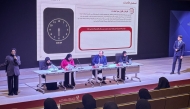
Participants in the Katara Mosque lecture.
The first of lectures of Katara Mosque were launched on Monday with a huge number of attendance. This is being organised by the Cultural Village Foundation, Katara, in cooperation with the Ministry of Endowments and Islamic Affairs.
H E Sheikh Dr. Othman Al Khamis gave a lecture on “The virtue of supplication,” which is one of the best acts of worship and the most beloved to God, stressing that supplication is worship. He explained that supplication is of two types: the first is supplication of the question, which is to ask God Almighty by His grace from the goodness of this world and the hereafter, as in his saying Almighty: “And if my servants ask you about me, then I am close. I respond to the supplication of the one who supplicates when he supplicates.”
The second supplication of worship, such as prayer, fasting, pilgrimage, zakat, charity, and other acts of worship by which we draw close to God Almighty.
Dr. Al Khamis referred to the virtue of supplication, which is one of the noblest acts of worship, and its importance, for there is nothing more honourable to God, Lord of the Worlds, than the supplication of His servants, who are humble and beseeching. He cited what the Messenger of God, peace and blessings be upon him, said: “He who does not ask God will be angry with him,” explaining that a sane Muslim is the one who often supplicates to God Almighty, and God asks him to do so, as in the noble verse: “And your Lord said: Call upon Me, I will respond to you.”
Especially since we are in the blessed month of Ramadan, which is the month of supplication and reading the Quran, where God made the supplication of the fasting person answered when he breaks his fast. In prostration, the servant is closest to his Lord.
Sheikh Al Khamis pointed out that there are six conditions in prayer in which supplication is prescribed, which are: “when the takbeer, bowing, rising from bowing, prostration, between the two prostrations, after the tashahhud and before the greeting.” He noted that it is Sunnah for the worshiper behind the imam if he passes by a sign of mercy to ask God Almighty from his mercy, and seek refuge with him from punishment if he passes through any punishment, and to glorify God when he hears the verses of glorification, indicating that the best of what we pray to God Almighty are the collections of words transmitted from the Prophet, may God bless him and grant him peace, and the supplications that were mentioned in the Holy Quran, avoiding what Our Noble Messenger warned us against praying for sin or severing ties of kinship.
He mentioned that the obstacles to the acceptance of supplication are many, the greatest of which is eating the forbidden, which obscures God’s pardon and mercy, while being keen on what is lawful in restaurants and bars makes supplications desirable for acceptance, emphasising that the supplication of a believer is not rejected. He delays it for him in the hereafter, so he finds it good on a day when he needs it most.