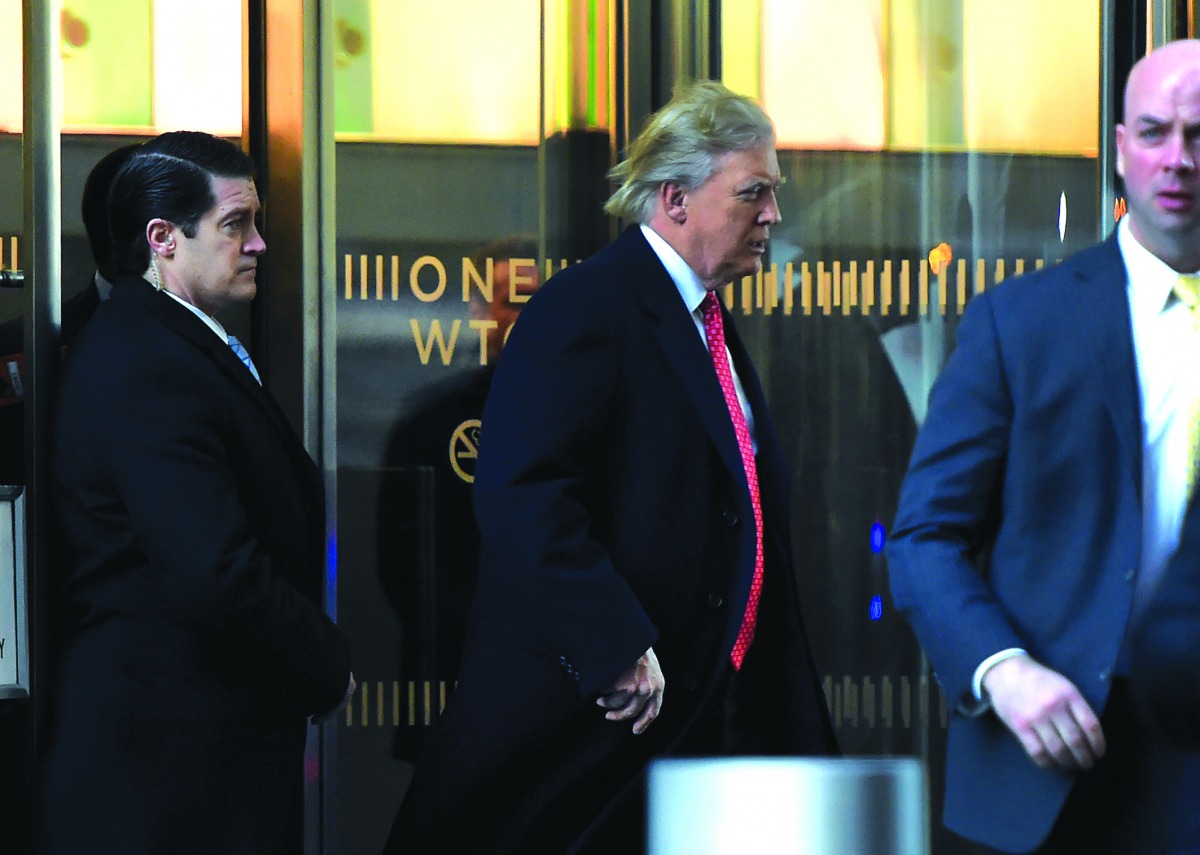
President-elect Donald Trump leaving One World Trade Center after a meeting with editors at Conde Nast in New York, yesterday.
Aday before US intelligence agencies take their case on hacking during the 2016 campaign directly to Donald Trump, spy chiefs publicly rebuffed the president-elect’s criticism of their work and reiterated that Russia’s most senior officials authorised the e-mail theft and disclosures.
“There is a difference between scepticism and disparagement,” Director of National Intelligence James Clapper told the Senate Armed Services Committee on Thursday when asked about Trump’s repeated questioning of the intelligence agencies’ conclusions and reliability. “Public trust and confidence in the intelligence community is crucial.”
Clapper, CIA Director John Brennan and FBI Director James Comey are scheduled to brief Trump Friday on the hacking and leaks of e-mails from Democratic officials and organizations backing his campaign rival Hillary Clinton. They’ll face a skeptical interrogator in the president-elect, who has said “hacking is a very hard thing to prove” and that intelligence agencies have been wrong before.
But Clapper told the Senate panel that the intelligence agencies’ confidence in their findings is now “very high” and they are “even more resolute” in their findings about Russian involvement than when they first weighed in on the issue publicly on Oct. 7. Yet Clapper also emphasized that Russian hacking didn’t change the vote count that made Trump president.
He testified alongside Undersecretary of Defence for Intelligence Marcel Lettre and Admiral Michael Rogers, who leads both the National Security Agency and US Cyber Command.
The hearing — called by Republican Senator John McCain of Arizona — highlighted a divide between Trump and some of his party’s most influential foreign policy hawks in Congress. Trump has repeatedly praised Russian President Vladimir Putin, while McCain and other lawmakers have said Russia, which has repeatedly denied the hacking accusations, should be punished with stiffer sanctions.
Republican Senator Lindsey Graham of South Carolina said “Putin is up to no good” and “it is time now not to throw pebbles, but rocks.” Addressing Trump’s barbs against the intelligence community, Graham said: “Mr. President-elect, when you listen to these people you can be sceptical, but understand they’re the best among us and they’re trying to protect us.”
Clapper said it “would be a good thing” if the US and Russia could find areas where the countries’ interests could “converge,” as has happened in the past, “but there’s a threshold of behaviour that’s unacceptable.”
In a series of tweets starting Jan. 3, Trump called an alleged delay in his briefing on the Russian hacks “very strange” and went on to quote an interview with fugitive WikiLeaks founder Julian Assange, who said on a Fox News opinion show this week that “a 14-year-old” could be responsible for computer breaches of Democratic Party offices last year. “Also said Russians did not give him the info!” Trump added in his posts.
Clapper and Rogers both said Assange had put US lives in danger by publishing classified material on WikiLeaks in the past and shouldn’t be a credible source on the hacking issue. The intelligence community doesn’t have a “whole lot of respect for him,” Clapper said. When questioned if Trump’s comments are hurting morale among intelligence officers, Clapper said, “I hardly think it helps.”
Trump pushed back ahead of the hearing, saying on Twitter that “The dishonest media likes saying that I am in Agreement with Julian Assange - wrong. I simply state what he states, it is for the people...to make up their own minds as to the truth. The media lies to make it look like I am against ‘Intelligence’ when in fact I am a big fan!”
President Barack Obama said in a television interview Thursday that “it’s going to be important to make sure the president and the intelligence communities are both working on the best possible information.”
“My hope is that when the president-elect receives his own briefings and is able to examine the intelligence as his team has put together and they see how professional and effective these agencies are, that some of those current tensions will be reduced,” Obama told WMAQ-TV in Chicago.
Ultimately, even if Trump doesn’t trust the intelligence agencies’ judgment on Russia, he will need their help to understand other foreign policy issues and cybersecurity threats, including from China, Iran and North Korea, Beau Woods, deputy director of the Atlantic Council’s Cyber Statecraft Initiative in Washington, said in interview.
“The conclusion of the intelligence community was that they like skepticism -- they’re in the business of being skeptics themselves,” Woods said. “However, to out-of-hand dismiss or disparage the intelligence that comes out of their processes, it’s unhelpful for finding the truth.”
At the start of the hearing, McCain, the committee’s chairman, called Russia’s hacking an “unprecedented attack” on US democracy. He said “every American should be alarmed” by Russia’s attack.
In prepared remarks, the intelligence officials said Moscow “poses a major threat” to US government, military, diplomatic, commercial and critical infrastructure networks. They also said Russia has developed a “highly advanced offensive cyber program.”
“Looking forward, Russian cyber operations will likely target the United States to gather intelligence, support Russian decision-making, conduct influence operations to support Russian military and political objectives, and prepare the cyber environment for future contingencies,” their statement said.
Clapper told the Senate panel that intelligence officials plan to brief Congress behind closed doors and release an unclassified version of their review to the public early next week.
Although there are some sensitive sources and methods, he said he intends to “push the envelope as much as I can,” he said.
“The public should know as much as possible,” said Clapper, who described himself as “apolitical.” “We’ll be as forthcoming as we can.”
The White House already has the intelligence review, which Obama ordered be completed before he leaves office, White House Press Secretary Josh Earnest told reporters Thursday.
“Men and women of the US intelligence community are patriots. They’re experts. They’re dedicated to getting the facts right,” Earnest said.