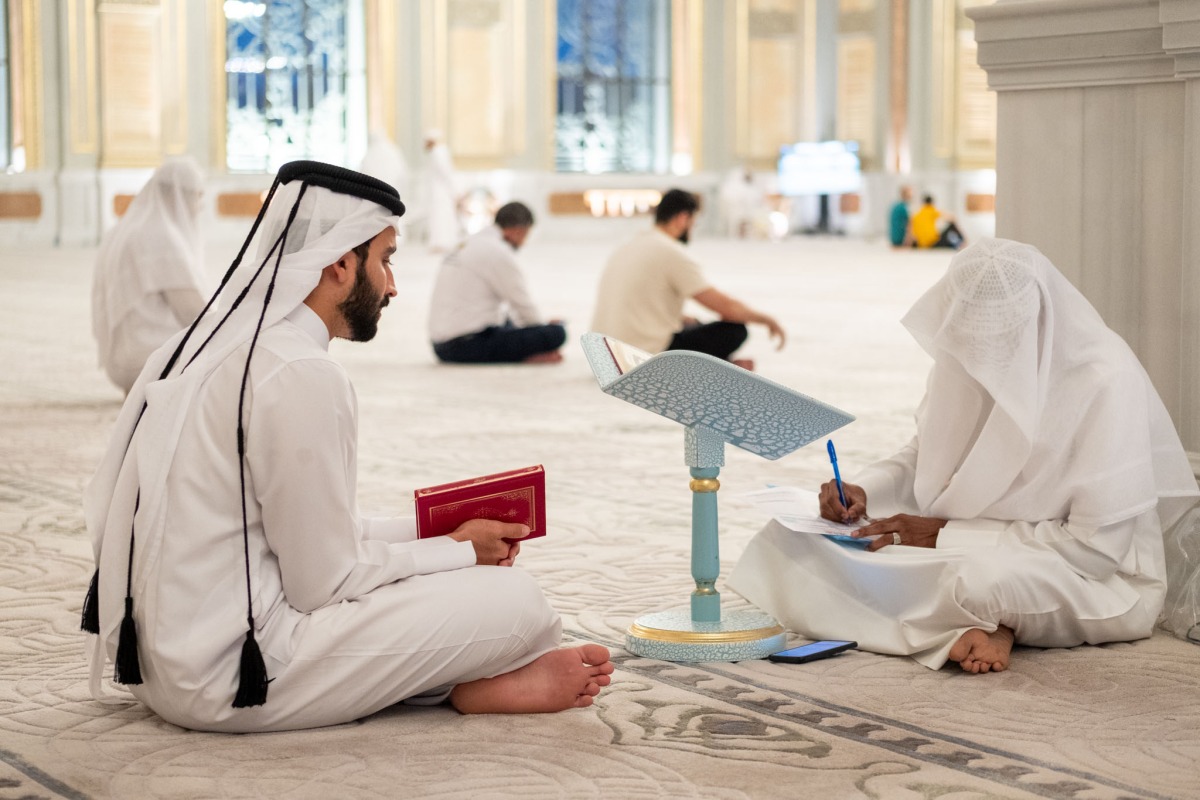
A participant with a teacher during a session of the Quran recitation programme.
Doha, Qatar: The Ministry of Awqaf and Islamic Affairs, represented by the Department of Da’wah and Religious Guidance, concluded recently, the second part of the “Tamkeen for Recitation of the Clear Quran” programme for 2026.
The programme was organised by the Quran and its Sciences Section at Sheikh Hamad bin Jassim bin Jabr Al Thani Mosque in The Pearl area, witnessing wide participation from Quran memorisers and members of the public. The event reflected the community’s deep connection with the Holy Quran and the Ministry’s commitment to providing initiatives that support memorisation and mastery of the Quran.
The programme recorded notable participation from 227 participants, including 70 complete Quran memorisers, highlighting its position as one of the specialised Quranic initiatives that promote the culture of continuous engagement with the Quran, encourage memorisers to regularly revise their memorisation, and strengthen their mastery.
The programme was held over two weeks through four Quranic gatherings conducted every Friday and Saturday.
Participants joined specialised sessions to recite portions of the Holy Quran in a spiritual and educational atmosphere that encouraged positive competition among Quran memorisers.
Jassim Abdullah Al Ali, Director of the Department of Da’wah and Religious Guidance, said the programme is among the specialised Quranic initiatives organised by the Ministry and supervised by the Quran and its Sciences Section.
He explained that the programme targets male participants from the general public who meet the participation requirements, particularly mastery of the memorised portions and commitment to the programme’s guidelines.
Al Ali said the programme was divided into four Quranic tracks, allowing participants to select the level suitable for their memorisation capacity and ability to revise and recite, thereby expanding participation opportunities and maximising the benefits of the Quranic gatherings.
As part of preparation and implementation, the department established 50 Quranic circles distributed across the different tracks.
It also selected a group of experienced and qualified Quran teachers and Quran memorisers to supervise the recitation gatherings and follow up with participants, ensuring the highest standards of quality and proficiency.
Head of the Quran and its Sciences Section, Fahad Ahmed Al Mohammed explained that the programme included various tracks covering recitation of the entire Quran in two sessions.
Recitation of half of the Quran in one session, either from the beginning (Al-Baqarah to Al-Isra) or from the end (Al-Kahf to An-Nas).
Recitation of one-quarter of the Quran in one session, either from the beginning (Al-Baqarah to Al-An’am) or from the end (Ya-Sin to An-Nas).
Recitation of five parts (juz’) of the Quran from either the beginning or the end.
These tracks were designed to meet the needs of different groups of Quran memorisers.
He noted that participants who completed the required portion and achieved a rating of “Good” or higher would receive achievement certificates as encouragement to continue pursuing excellence and mastery.
A number of participants praised the programme, describing it as a valuable opportunity to engage with the Holy Quran and revise their memorised portions in a motivating spiritual environment inside the houses of Allah.
They said the programme helped improve concentration, self-confidence and assess their ability to maintain continuous recitation.