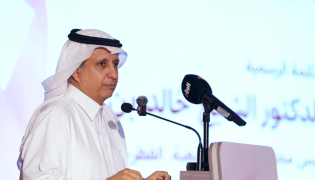
Doha: The College of Law at Qatar University (QU) was selected as the Best Worker in Workers’ Welfare of the Year 2020, in a ceremony under the auspices of the Ministry of Administrative Development, Labor and Social Affairs (ADLSA), entitled “Workers’ welfare is a moral duty and legal obligation.”
This selection was made by the Workers Welfare Awards Committee headed by Mohammed bin Tawar Al Kuwari, Vice-President of Qatar Chamber. The Committee was launched by Dar Al-Sharq about five years ago.
The Committee includes representatives of the National Human Rights Committee, the Department of Occupational Safety and Health at the Supreme Committee for Delivery and Legacy, the Community Police, the Labor Inspection Department at ADLSA, Public Relations at the Public Works Authority, and several professors from QU.
The Committee presented honorary awards for the Best Company in Worker Welfare during the Coronavirus pandemic, Best Company in Worker Accommodation, Best Company in Occupational Safety and Health, Best Worker of the Year 2020, and Best Personality in Worker Welfare for the year 2020. Dr. Khaled bin Saleh Al-Shammari, Assistant Dean, received the award on behalf of the College.
The Committee commended the efforts made by the Legal Clinic at the College of Law in assisting vulnerable groups, especially migrant workers, in various labour cases, including breaching the terms and conditions stipulated in work contracts, especially those related to wages and end-of-service benefits, and other obligations imposed on the employer.
The legal clinic is also preoccupied with criminal and civil cases, including refund claims of sums paid before the pandemic, issues related to the payment of bank loans, sales and lease contracts and commercial partnership, and personal status issues, especially those related to marriage and alimony, child support and domestic violence.
The Committee commended the research project carried out by students of the Faculty of Law in the fall 2020 semester, which dealt with the legal effects of the pandemic on contractual obligations in employment contracts, in partnership with thirty legal clinics in universities from twenty countries: Spain, India, the United States, South Africa, Croatia, Nigeria, Morocco, Australia, New Zealand, Jordan, United Kingdom, Pakistan, Malawi, Oman, Kuwait, Tunisia, Canada, Romania, Turkey, and Qatar.
The Committee reviewed the final report, which included the results of the research project and the recommendations it reached.
The Committee also referred to the role of the College in enriching research related to labor and workers issues and raising awareness of their rights under the Qatari legislative system, which includes Labor Law No. (14) of 2004, Law of Entry, Exit and Residence of Expatriates No. 21 of 2015 and the amendments. Domestic Workers Law No. (15) of 2017, Anti-Human Trafficking Law No. 15 of 2011, and legislative developments for 2020, including abolishing the sponsorship system and setting the minimum wage for workers.