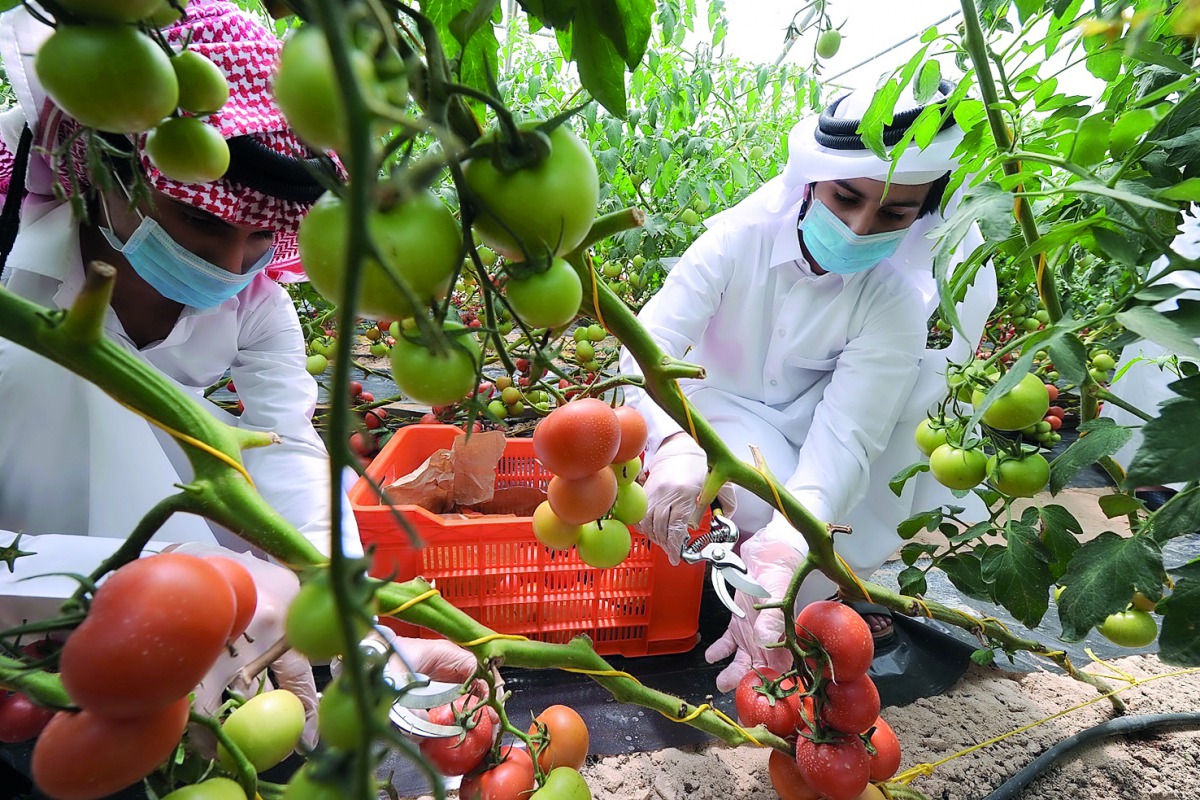
Students learn farming techniques at a farm as part of an initiative by QF.
DOHA: To support Qatar’s mission to achieve self-sufficiency in food sector, Qatar Foundation has also played an active role in the post siege scenario by launching various initiatives from its affiliated institutes.
Qur’anic Botanic Garden (QBG), a member of Qatar Foundation (QF), successfully established an ambitious programme for high school students designed to promote the value of food sustainability.
As part of the ongoing programme, students attend workshops at QBG and learn from experts from the Ministry of Municipality and Environment and the private sector. Participants are also given the opportunity to meet with local business people who work within the food industry to learn about the challenges and obstacles that they face on a day-to-day basis.
Additionally, QBG houses a small-scale farm on-site at Education City, growing a variety of fruits, vegetables, and herbs, including tomatoes, onions, garlic, parsley, and dill—enabling students to learn first-hand how to cultivate produce.
“We discovered that many young people, and high school students in particular, don’t know much about agriculture, and their knowledge of the importance of food security is limited. Therefore, the main aim of this programme is to provide basic information to students and equip them with the practical skills to help grow the domestic agriculture industry. Ultimately, through this initiative, we are investing in the future of Qatar,” said Fatima Saleh Al Khulaifi, Project Manager, QBG.
Explaining plans to expand the initiative, Al Khulaifi added: “This is the first year of the programme, and our goal is to increase the number of schools and participants. We’d like this initiative to grow and gain traction across the nation.”
Weill Cornell Medicine–Qatar (WCM-Q), a QF partner university, is another entity working towards food sustainability. ‘Project: Greenhouse’, part of WCM-Q’s ‘Sahtak Awalan – Your Health First’ campaign, aims to teach children about the environment, sustainability, how to grow fruits and vegetables, and the importance of adopting a healthy diet.
So far, WCM-Q has provided greenhouses to more than 130 public elementary schools across Qatar, as well as seeds, soil, and instructions on how to cultivate plants.
In February 2018, ‘Project: Greenhouse’ expanded to include a brand-new initiative, ‘Khayr Qatarna’, which is helping to promote food security and self-sufficiency in Qatar by installing three large-scale, climate-controlled greenhouses at select schools.
These greenhouses, run by professional gardeners, are being used to grow fruits and vegetables for distribution through local supermarkets under the Khayr Qatarna brand, with all proceeds being reinvested into the project. As the project continues to develop, WCM-Q aims to include additional schools and build more greenhouses, with the possibility of increasing the range of fruits and vegetables that are grown.
Commenting on the programme, Nesreen M Al Rifai, Chief Communications Officer, WCM-Q, said: “The concept of food sustainability and food security is vital for Qatar. If there is one positive aspect of the blockade, it has provided Qatar with the impetus to take responsibility of its own food production.
Khayr Qatarna wants to complement this, providing the community with fresh, locally-grown food sold under the Khayr Qatarna brand and also allowing our children to take a role in the nation’s food security. In November 2017, QF also launched Torba Farmers Market in Education City.