Strategic Vision
What are the key challenges and opportunities you see for the College of General Education at the University of Doha for Science and Technology today, and how are you working to align the College’s vision with Qatar’s national goals?
The College of General Education (CGE) is the first experience new students will have of university life and study – it is the gateway for every first-year student into their academic program, and also the time when they develop critical skills for success. At CGE, students will gain the essential knowledge, skills, and competencies across the core academic disciplines which are embedded in all programs of study.
CGE will also introduce students to the distinctive pedagogies and learning approaches common to the STEM disciplines and TVET, with a particular focus on applied and experiential learning, teaching students to think critically and communicate effectively and to develop the principles of personal and social responsibility necessary for advancing their intellectual and practical skills.
This task presents both challenges and opportunities in the fact that first-year students come from very diverse backgrounds and often need support to grow into independent and pro-active learners. This is what actually makes learning and teaching at CGE so much more rewarding and exciting because we enable our students to flourish in their academic journey.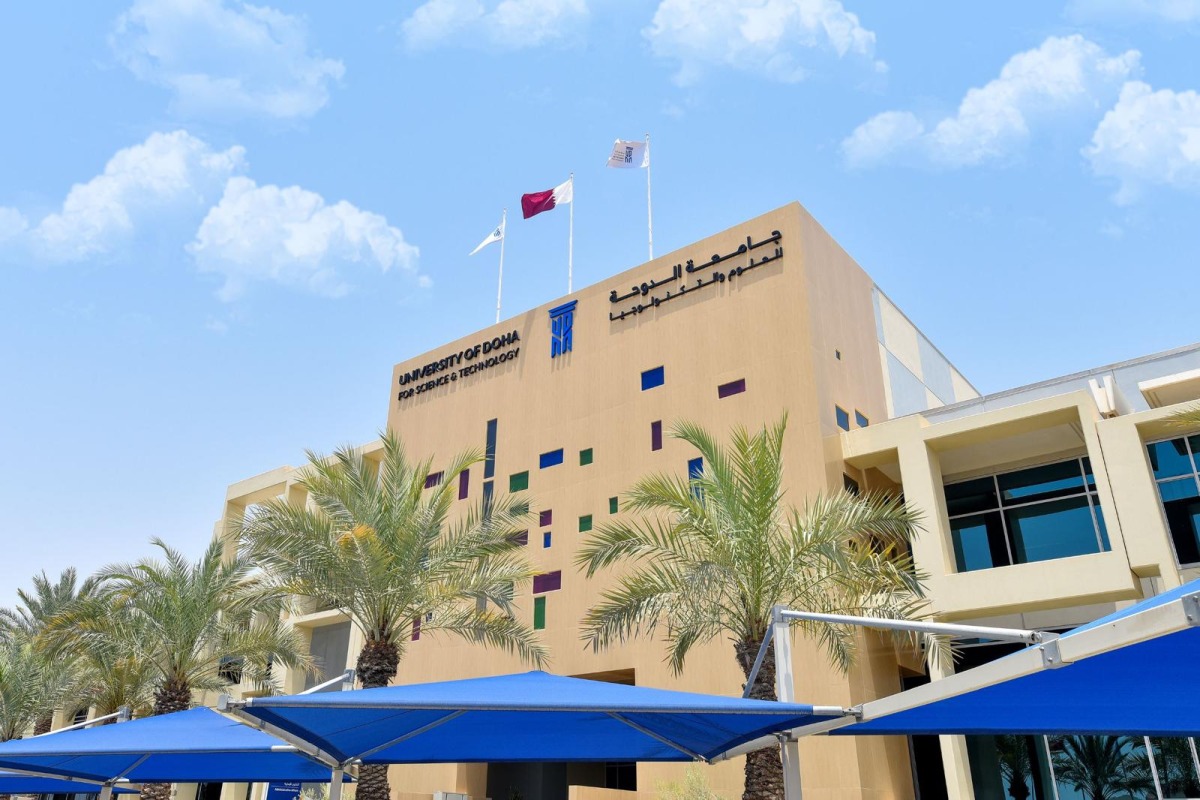 Like all of UDST programs, CGE’s innovative degree programs in Teaching STEM, and STEM and TVET Education contribute directly to the Qatar national goals to increase the percentage of students graduating from STEM fields. CGE – through its Department of Applied Education – is dedicated to preparing a new generation of STEM teachers to achieve this goal.
Innovation in Teaching
How does the College of General Education’s curricula reflect digital transformation and the evolving needs of the employment market? Are there specific initiatives to integrate artificial intelligence into teaching and assessment methods?
As an applied university, UDST is home to programs that utilize digital technologies extensively, with the aim of serving the evolving needs of the employment market.
In CGE, these experiences come from adaptive learning digital platforms such as McGraw Hill’s ALEKS and SIMnet, Pearson’s dynamic study modules such as MyLab Mastering, and Cengage’s WebAssign. Each of these platforms provide AI generated feedback to students as personalized adaptive learning pathways, based on how students respond to the questions.
Beyond the use of adaptive learning platforms, the College’s curricula are closely tied to UDST’s advanced digital and physical infrastructure. Teaching STEM programs routinely makes use of simulation laboratories, maker spaces, artificial intelligence modelling labs, and virtual-reality-enabled classrooms that mirror real-world professional environments.
These facilities allow student teachers to experiment with robotics, coding, 3D printing, data acquisition, and digital simulations as part of their coursework in Technology in STEM Education and School/Industry Experience. In parallel, the graduate level curricula for teachers at our Master of Science in STEM and TVET Education program embed computational thinking, mathematical modelling, and project-based learning around socio-scientific issues, positioning AI not only as a tool for feedback and analytics but also as an object of critical inquiry. In this way, digital transformation is built into both the content and pedagogy of the College’s programs, keeping teaching and assessment practices responsive to the evolving labor market.
Faculty Development
What strategies are being implemented to ensure the continuous professional development of faculty members and to encourage them to engage in applied, community-relevant research?
CGE faculty are at the forefront of professional development activities, both on a personal level through professional and academic association memberships, as well as the wide-reaching programs organized by the Applied and Experiential Learning Department of the University.
Of special note is the Harvard-UDST Instructional Leadership Certificate Program - a dynamic, four-course series designed to strengthen teaching leadership skills. Guided by Harvard experts and grounded in peer collaboration, this program empowers educators to lead adult learners, address common challenges in teaching and learning, and apply leadership practices within their academic contexts. Dr. Rosie Bateson
Research is one of three pillars of the academic careers of UDST and CGE faculty, along with teaching and service. Led by the Applied Research Strategy of the University, CGE faculty members actively contribute to the University’s research agenda and have won a number of competitive QRDI grant awards.
Curricula and Academic Programs
New Programs
Is the College planning to launch any new academic programs or interdisciplinary specializations that address current knowledge gaps in the field of general education?
In addition to the 70+ courses which form the General Education Requirements of the University, CGE is home to a new Department of Applied Education which offers three new programs, launched with strong support from the Ministry of Education and Higher Education and its Tomouh Scholarship Program:
Collectively, these three programs form a coherent ecosystem of pre-service and in-service teacher education that is distinctive in Qatar and the wider region.
The Bachelor of Science in Teaching STEM addresses the long-term pipeline by preparing high-school graduates as bilingual, integrative STEM teachers, while the Master of Science in Teaching STEM and the Master of Science in STEM & TVET Education offer progression routes for graduates of STEM disciplines and practicing teachers who wish to deepen their pedagogical and research expertise.
All three programs are aligned with the Qatar National Qualifications Framework and the Qatar National Professional Standards for Teachers, and have been developed in consultation with a Program Advisory Committee comprising school leaders, policy makers, and industry partners. This design ensures that the programs remain responsive to labor-market demand, national reform agendas, and school-level needs across primary, preparatory, and secondary education.
Quality of Outcomes
How do you measure the quality of graduates from the College of General Education? What core soft skills do you prioritize to ensure they are fully prepared to enter the teaching profession?
These Programs prepare future educators to deliver interdisciplinary STEM Education in diverse and dynamic international learning environments. Aligned with national standards and Qatar National Vision 2030, the programs foster critical thinking, creativity, and problem-solving skills. At the graduate level, the programs promote interdisciplinary teaching approaches, critical thinking, technology integration, and culturally responsive pedagogy. Through rigorous coursework, graduates are equipped to design and implement forward-thinking STEM and TVET curricula that inspire learners, enhance engagement, and address diverse educational needs.
Practical and Experiential Learning
How is field training and practical experience integrated into the educational process, and what partnerships are currently in place with schools and educational institutions to strengthen this component?
The Bachelor of Science in Teaching STEM is designed with three practical and experiential learning experiences embedded in the program, starting in the second year as teaching observation, to practical experience of co-teaching in the third year, which culminates in a Teaching Practicum in the final year. CGE collaborates with a range of public and private schools to enable these teaching placements for all students enrolled in the program.
A similar approach is applied to the Master of Science in Teaching STEM, a graduate level teacher training program offered for students who have completed undergraduate degrees in STEM subjects.
In addition, the establishment of a dedicated STEM Teaching Lab—with robotics kits, sensors, 3D printers, and an observation room—provides a bridge between campus-based methods courses and practicum experiences, enabling student teachers to design, rehearse, and analyze integrative STEM lessons before and after they are implemented in schools.
Research and Community Engagement
Applied Research
What research areas is the College currently focusing on within the context of Qatar’s educational environment, and what are the key research achievements you would like to highlight?
CGE’s faculty have a wide range of research interests, covering the diverse subjects offered by the College in math, science, social sciences, humanities and research methods. These include education research in topics such as factors influencing student success, how young learners perceive STEM subjects and gender balance, research in science and its applications, and mathematical modelling. CGE faculty have consistently won Undergraduate Research Experience Projects (UREP) grants supported by the Qatar Research, Development and Innovation (QRDI) Council, which provide a valuable experience for undergraduate students to engage with scholarly research.
Within this landscape, the new Master’s program in STEM & TVET Education plays a central role in consolidating the College’s applied research agenda. The curricula include dedicated courses in quantitative and qualitative research methods, followed by Thesis I and II, where students investigate problems such as the integration of computational thinking into STEM curricula, the impact of project-based learning around socio-scientific issues, mathematical modelling in school and TVET settings, and the implementation of national policies in classrooms. These theses are expected to address real challenges faced by local schools and training centers, aligning with national strategies that call for applied research to inform policy and practice.
Engagement with Parents
How does the College help empower parents and raise their awareness of the latest educational practices? Are there any guidance or orientation programs specifically designed for them?
UDST and CGE engage with parents during numerous information sessions promoting the University programs. Parent play a critical role in their children’s choice of career and academic pursuits. CGE believes that well-informed parents will nurture their children’s passion for learning and choice of the most suitable academic program for them.
National Participation
How does the College support nationalization and Arabic initiatives within the curriculum? Is there collaboration with the Ministry of Education and Higher Education for knowledge exchange and policy development?
As a national university, UDST – through all its colleges – seeks to advance the National Development Strategy and the priorities set out by the Ministry of Education and Higher Education. This translates in regular dialogue for knowledge exchange and policy development, including the new Bachelor in Teaching STEM and the Master’s Programs, which directly contribute to advancing the national agenda.
In addition, CGE offers some of its courses in bilingual (English and Arabic) delivery. Courses dedicated to Qatar’s contemporary history, Qatar’s Human Development, and Islamic and Arab Civilization are a requirement of the General Education curriculum. CGE is also planning to introduce courses in Arabic for non-Arabic speakers, as a means of bringing together students as a pluri-lingual community.
Personal and Professional Challenges
Most Significant Challenge
As the Dean of a leading college, what has been the greatest personal or professional challenge you have faced since assuming this role, and how were you able to overcome it?
I feel privileged to be part of the UDST community and to have contributed to the institution’s growth and development. The journey of a leader is always challenging but I see every challenge as an opportunity to learn, create, test new ideas, and bring the best people around me to solve the problems we face. My strong belief is that a leader can be successful only when the team they lead are equally enabled to be successful.
Role Model
What role does female leadership play in Qatar’s higher education sector, and what advice would you offer to young female researchers and academics?
Qatar’s strong and capable female leadership is visible at every level, symbolic of the nation’s high ambition and immense progress. My advice to all female students, researchers and academics is to aim high and never settle for second-best. Contemporary technology and AI are great enablers of education and career development - I encourage all to be resilient and follow their aspirations with confidence.
Final Message
If you could send one message to high school students who are about to choose their majors, what would you tell them about the importance of the teaching profession?
I believe that every person will remember at least one teacher who has been instrumental in shaping heir lives. Next to parents, teachers are the greatest formative influence on young minds – to be a member of the teaching profession is to be empowered to shape the future.