

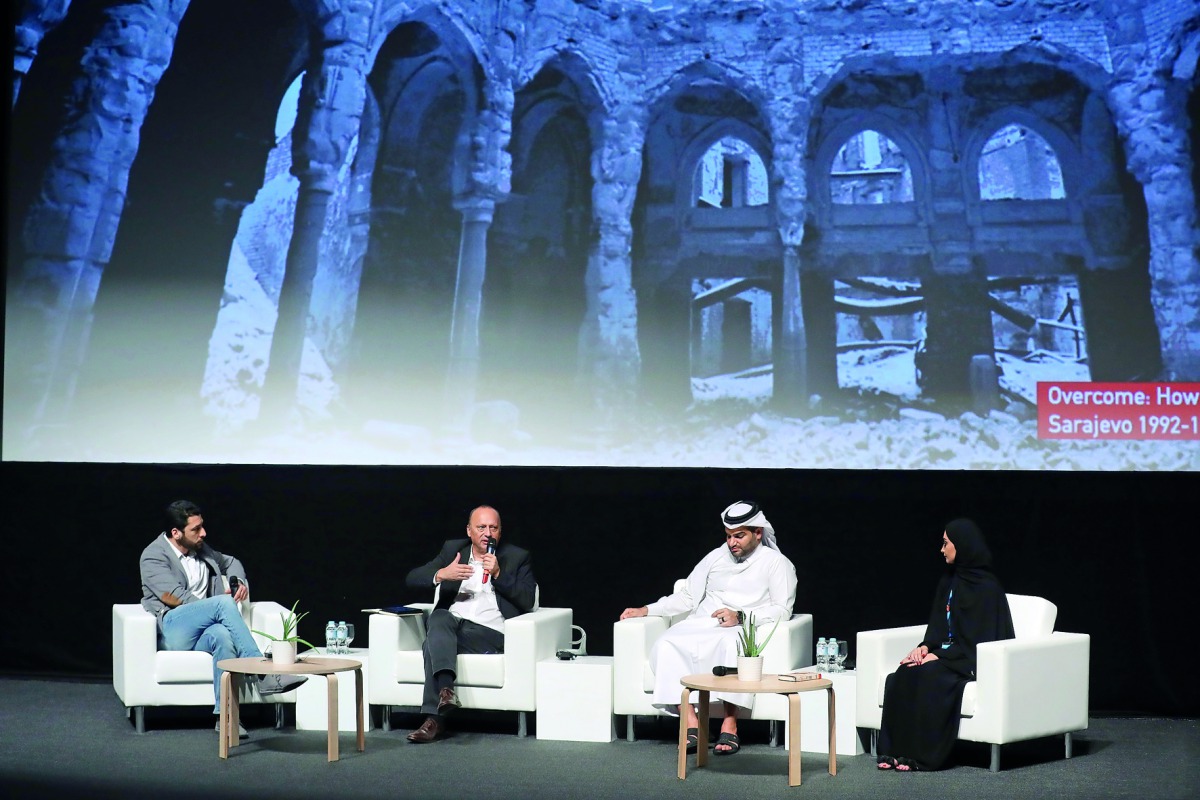
Moeed Ahmad, Mirsad Purivatra, Abdulaziz Youssef and Shoug Shaheen speak on stage during the talks on ‘Overcome: How art beats adversity’ at Ajyal Youth Film Festival in Doha.
The power of art during period of struggle and the illicit global trade in child captives were the subjects discussed at the second and third sessions of Ajyal Talks, held as part of the Ajyal Youth Film Festival presented by the Doha Film Institute (DFI).
Shoug Shaheen, broadcast journalist, Abdulaziz Youssef, artist and co-founder of Qartoon and Mirsad Purivatra, Director of the Sarajevo Film Festival, shared their experience of this phenomenon during a discussion entitled ‘Overcome: How Art Beats Adversity’. It was moderated by Moeed Ahmad, a journalist at Al Jazeera.
Shoug Shaheen began by recalling her initial reaction to the news and how it made her want to make the world understand Qatar’s position. “I discovered so many new artworks as a result of the blockade. Let’s look at the positive side. It revived art and united the people even more. The greatest evidence is that we are all here tonight.”
Abdulaziz Youssef also talked about how he turned to art and began to draw caricatures when he knew about the blockade. Normally, he said, he might draw one in a day. That day he drew 30. “I understood that I had a lot to say,” he explained, and added that the unfairness of the blockade gave him the energy to work harder and faster. “Before it used to take me two or three weeks to draw a 30-second animation. Now I do the same thing in 2 or 3 hours.”
Dr. Mohammad Mattar, Professor of Law at Qatar University, Sky Neal, documentary filmmaker, Elhum Shakerifar, producer and programmer and Jenna Dawson-Faber, United Nations Office on Drugs and Crime representative and moderator of the panel discussion, shared their insight of the trade during a discussion entitled ‘Not For Sale: A Focus on Child Trafficking’. Also in attendance were Sunita Sunar and Bijay Limbu, two of the Nepali child survivors profiled in the film, who are members of Circus Kathmandu, the circus/rehabilitation camp that helps child survivors of circus trafficking.
Mattar congratulated Qatar for its adoption of human trafficking legislation and its work on identifying potential victims. “Human trafficking is a gross violation of human rights, a violation on children, a crime against the state and a crime against humanity,” he said. He added that while children account for only 28 percent of all trafficking cases, they are in many ways the worst cases.
Neal, who began making her film in 2010 and has a performing arts background as an aerial artist said that when she first heard of children being trafficked to circuses, she was shocked to discover that a world she loved so much had such a dark side. “Even if they get rescued, these children are stigmatised and often rejected by their families.
They have such amazing, incredible skills but they are ashamed of them,” she said and suggested that this was kind of triple punishment: first by being trafficked and abused, then by being rejected and then by self-loathing.
Limbu, who was rescued at the age of 12 after spending four years indentured to a circus, said that even after his rescue, he found it difficult to interact with other circus survivors. Sunar, who spent 8 years in captivity, said that not a single day went by without her hoping a friend or a family member would rescue her.
Shakerifar stressed that with the film, she wanted to reframe the narrative. “These children are not victims, they are survivors,” she said to some applause.






