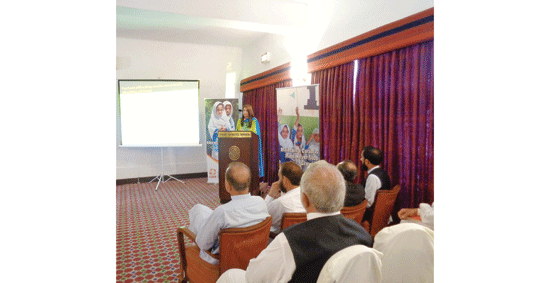
Doha: Reach Out To Asia (ROTA), a member of Qatar Foundation for Education, Science and Community Development (QF), has launched the ‘Institutional Support for Participatory, Inclusive and Responsive Education’ project in collaboration with CARE International, a leading humanitarian and development organisation.
It aims to improve access to higher quality education for females in secondary school in the rural Swat district by introducing the concept of a double-shift school system, where teaching operates in two shifts, with one group of students in the building early in the day and a second group later in the day.
The system will make use of up to 35 existing government primary schools.
ROTA has launched the project to fulfil its mission of building cohesive societies through initiatives that give importance to the development of society and education for countries in need.
The project is in line with QF’s mission of promoting productive change regionally and internationally. It was formally launched on this September 12 and will continue for three years.
Essa Al Mannai, Executive Director, ROTA, said: “Our cooperation with CARE International is part of ROTA’s agenda to achieve equal educational opportunities with high efficiency and quality in areas with lesser degree of access to education and provide a suitable environment to achieve the goal.
“ROTA always cooperates with international and local organisations and bodies to enable and unlock the potential of young people to build a strong and sustainable community and help in the restructuring of the youth role to serve their communities.”
For the double-shift schools, 100 local teachers will be hired under flexible terms agreed with the education department.
Teachers will be provided with training during an Accelerated Learning Programme and the project aims to reach up to 1,000 female students. The initiative also aims to improve access to technical education through advanced training programmes.
It will provide vocational skills and entrepreneurship development to 300 young men and women through training and support and help up to 100 women working from home develop their own projects.
The aim is to develop skilled labourers who do not have a support system by enrolling them in small projects that will give them opportunity to work independently.
The programme will support 35 existing schools by providing them with supplies, equipment and facilities needed for a suitable and comfortable learning environment. It is also developing an action plan to overcome any obstacles to providing a quality education for girls through behavioural and community campaigns at local and regional levels.
The Peninsula