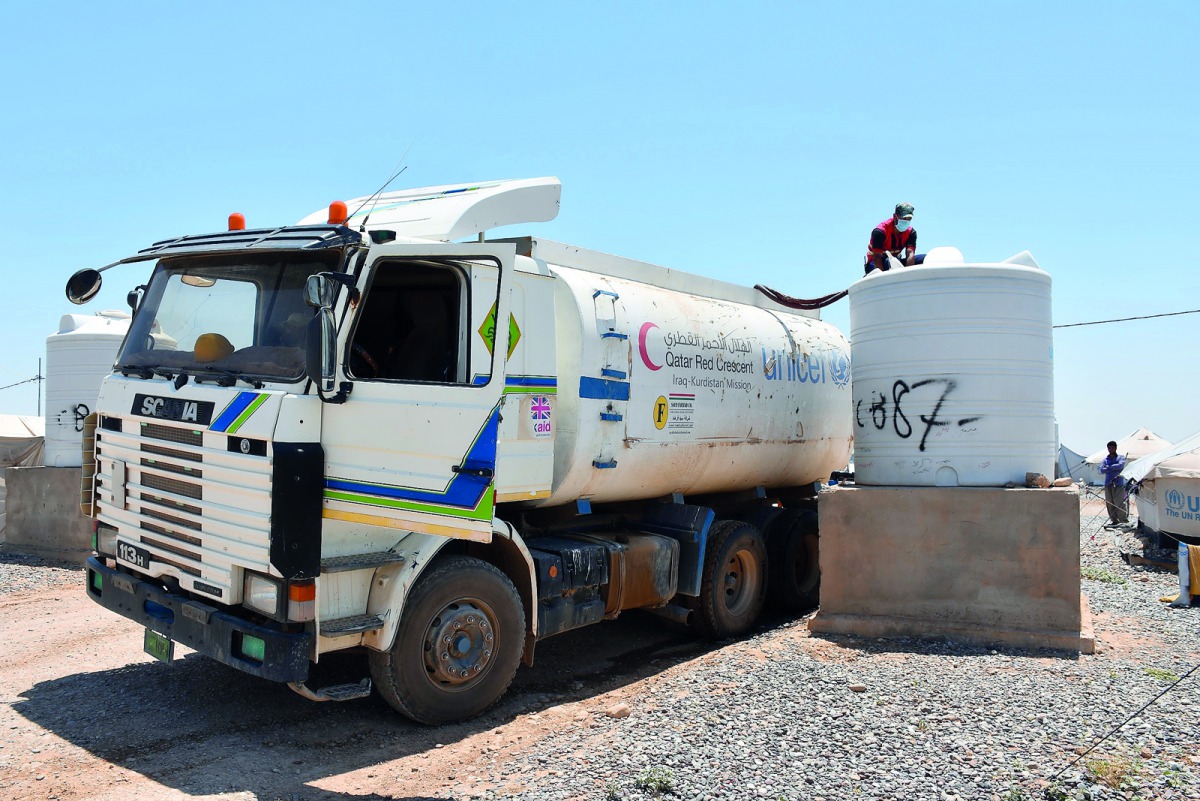
Qatar Red Crescent Society (QRCS) relief team distributing water in Al Salamiya camp.
DOHA: Qatar Red Crescent Society’s (QRCS) relief program in Mosul is making a steady progress, providing water, sanitation, and hygiene (WASH) services for more than 20,000 internally displaced people (IDPs) at the Al Salamiya IDP Camp.
Co-funded by the United Nations Children’s Fund (Unicef) and QRCS, the five-month project involves the distribution of drinking water, maintenance of sanitation facilities, removal of wastewater, and collection of garbage, said a release.
This intervention is designed to address the issue of lack of drinking water, sewage, and hygiene, as well as inadequate cleaning services. To alleviate the suffering of displaced communities, the project seeks to make the overpopulated camp livable, until the early recovery program is over and the IDPs return to their home towns.
As planned, a 40-liter ration of potable water is distributed to every inhabitant of the camp, 300 main containers are placed at each block, garbage trucks are deployed around the camp, wastewater is regularly drained, 40,000 hygiene kits are delivered, and water and sewerage systems are repaired.
Located halfway between Erbil and Mosul, Al Salamiya camp accommodates around 20,785 IDPs.
Here, families live in close proximity and visit each other. They meet at tent doors to socialize and take tea together. Typically, those forced to flee their homes tend to build new friendships and have a sense of shared destiny.
Outside of the camp, shops and kiosks are set up to sell the retail items not covered by humanitarian aid providers. One of these is Umm Taleb’s mini-market, a small cloth shed structure that contains wood boxes used as shelves and chairs. While her grandchildren play around, Umm Taleb sells snacks, eggs, and other staples to the inhabitants of the camp.
QRCS’s personnel carry out humanitarian programs and awareness sessions, while trying to keep the yard tidy. At the entrance, other kids are waiting for their turn to attend the funny but informative lessons.
Even though the IDP camp inhabitants have adapted to their everyday routine, they still face significant challenges. Inadequate resources mean that they do not have a regular access to humanitarian aid. Many families struggle to earn a living, which raises concerns over issues like child labor, child marriage, and hand cart boys.