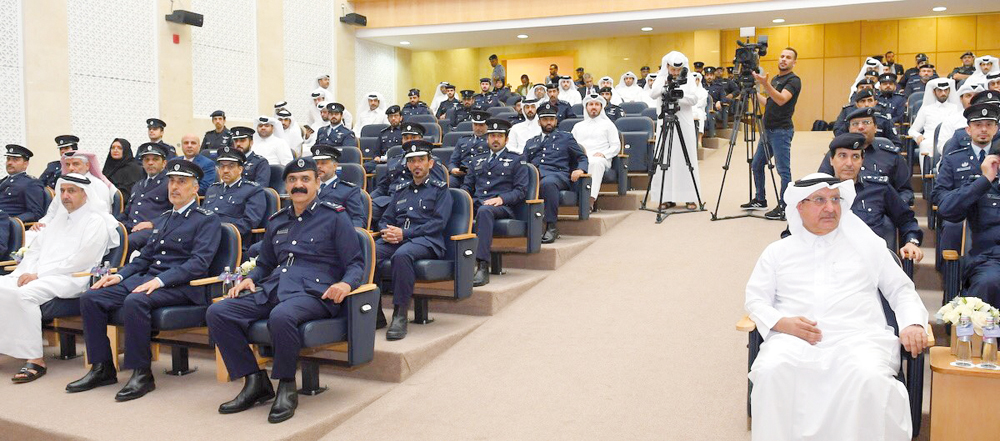
Participants during the seminar.
Doha, Qatar: A seminar held by the Ministry of Interior (MoI) yesterday shed light on the alternative to custodial sentences, its benefit, and its importance in reforming convicts to keep up with the criminal, correctional, and rehabilitative policy.
The seminar — which was attended by Legal Advisor to Minister of Interior, Maj Gen Dr. Abdullah Yousef Al Mal, who is also the general supervisor of the Police Academy and Director of Public Security H E Maj Gen Abdullah Mohammed Al Suwaidi — focused on axes related to defining mechanisms for activating alternative penalties and benefiting from them in combating crime, reducing criminal risk, and ways to enhance the efforts of criminal justice institutions in applying alternative penalties and modernizing the relevant legal system.
In his speech marking the occasion, Director of the Penal & Correctional Institutions Department (PCID) Brigadier-General Mohamed Saud Al Otaibi emphasised the importance of implementing alternative punishments in response to the rapid social, economic, and technological changes occurring worldwide. He noted that alternative punishments can change the notion that deterrence can only be achieved through imprisonment, which may have disproportionate impacts, while still maintaining imprisonment as a necessary deterrent.
Brigadier-General Al Otaibi added that alternative penalties maintain the cohesion of family and have positive effects on society, explaining that alternative penalties will play a major and important role in the next stage in solving the problem of prison capacity, which is facing most countries around the world.
In turn, Director of Security Research and Studies Centre Lt Col Dr. Jassim Mohammed Al Obaidly said that the successive developments in contemporary criminal policies related to reforming ‘the convict’ and determining how to implement the punishment with basic rules represented in the basic guarantees related to preserving human dignity and ensuring that punishment achieves its goals and the transmission of criminal thought and criminal policy to apply alternative penalties to custodial sentences.
The first session dealt with the social aspect of alternative punishments, where Major Bakhit Abdullah Al Baridi from the PCID presented a working paper on alternative punishments and their importance in the issue of prison capacity and alternative measures and their positive impact.
He also talked about the effectiveness of electronic monitoring (the electronic bracelet) and its most important areas, advantages, and benefits of using it as an alternative to custodial penalties.
For his part, Major Abdullah Misfer Al Shahwani Al Hajri of the Gulf Police discussed the alternative punishment models in the GCC countries, reviewing the nature and types of punishments and the models of some Gulf countries in this context and their experience in alternatives to custodial penalties, especially the electronic monitoring system by means of the electronic bracelet.
The second session discussed the legal side of alternative penalties where Abdulrahman Jassim Al Mannai, who is a prosecutor at the execution of judgments and checks, discussed the justifications for pretrial detention, types of alternatives to custodial sentences, precautionary measures, and social employment, in addition to the criminal order system.
For his part, Dr. Adel Yahya from the Police Academy highlighted contemporary punitive policy trends in the field of reducing the negative effects of short-term custodial sentences, explaining the science of penalties between the traditional concept and the modern concept.