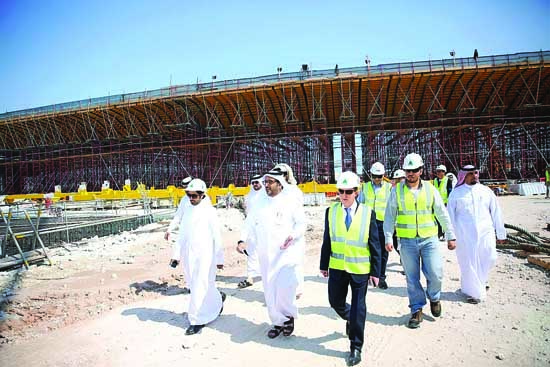
DOHA: A delegation from the Central Municipal Council (CMC) visited a number of worksites of the Lusail Expressway project yesterday.
The project is being implemented under Ashghal’s Expressway Programme. The project aims to reconstruct and upgrade the existing Lusail Road from the South of the Arch Roundabout to the North Canal Crossing, providing a vital link between Doha City and Lusail City through an advanced network of tunnels, interchanges and bridges.
The project includes three major multi-level interchanges: Al Wahda Interchange, Onaiza Interchange, and The Pearl Interchange. The project also includes the construction of roads leading to The Pearl, Katara Cultural Village, Lusail City, the Diplomatic area, and the commercial and residential areas in the neighboring areas.
The delegation consisted of Hamad Lahdan Al Muhannadi, the CMC Vice-Chairman and Head of Public Utilities Committee, Abdulrahman Al Khulaifi and Nasser Al Kubaisi, members of the Public Utilities Committee, and Nasser Rashed Al Muhannadi, Assistant Manager of Meeting and Member Affairs at CMC.
The delegation visited a number of the project’s worksites, the Pearl intersection, Onaiza intersection, and Al Wahda Intersection. The delegation was briefed about the project, the progress made in its implementation, as well as the engineering and construction techniques used in order to guarantee the completion of the project according the required standards and schedule.
Lusail Expressway will extend over 5.3km and will include four lanes in each direction, as well as additional lanes to ease the traffic flow between the interchanges. The project will also include the construction of approximately 3 km of infrastructure tunnels with internal diameters of approximately 3 metres to accommodate electricity cables of 132 kilowatt, and more than 1 km of infrastructure tunnels with internal diameter of 2.5 metre to drain the surface water.
The Peninsula