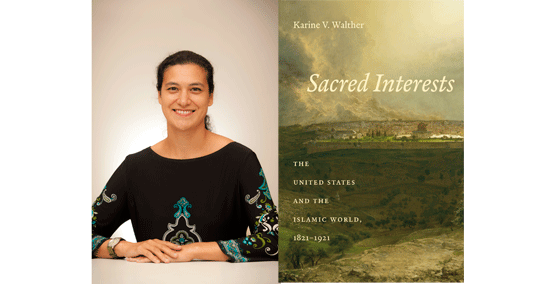
DOHA: A book tracing the history of American Islamophobia will be launched this evening at Georgetown University-Qatar’s School of Foreign Service’s public book store.
Its author, Professor of History at Georgetown University-Qatar, Karine Walther (pictured), will be at the store during the launch at 6pm.
The book — “Sacred Interests: The United States and the Islamic World, 1821-1921” — is a widely praised work.
It is about the deep history of American Islamophobia and shows how negative perceptions of Islam and Muslims shaped US foreign relations from the Early Republic to the end of World War I.
Early Republic is a reference to the US after the American Revolution (roughly from 1784 to 1800). World War I ended by 1918-end.
Dr Walther, an assistant professor of history at Georgetown University’s School of Foreign Service, holds a PhD in history from Columbia University.
To write the book, she has relied on research of American diplomatic archives and non-government sources such as the correspondence of protestant missionaries and humanitarian organisations.
She builds a clear picture of US reactions to, and involvement in, major events that were taking place in the Islamic world, including the break-up of the Ottoman Empire, Jewish life under Muslim authority in Morocco, American attempts to aid Christians during the Armenian Genocide (also known as Armenian holocaust or massacres) and American colonial policies in the Philippines.
The author examines the American role in the peace negotiations after World War I (Paris Peace Conference in 1919 which announced the formation of League of Nations; and the Treaty of Versailles).
Also examined is the American support for the Balfour Declaration of 1917 (the Declaration, as we know, is about British support for establishment of a “national home” for Jewish people in Palestine), and the establishment of the mandate system in the Middle East.
The mandate system refers to a League of Nations mandate granting legal status to certain territories transferred from the control of one country to another after World War I.
The system led to the creation of new states after the dissolution of the Ottoman Empire. A press statement announcing the book’s launch was released yesterday.
It said that the outcome of Walther’s in-depth research for the book is an important understanding of the crucial role the US played in the Islamic world during the 19th century.
This interaction, Walther says, is one that has “shaped a historical legacy that remains with us today. After 9/11, I saw negative stereotypes of Muslims that I had already seen in the 19th century European ideas of Islam so I became interested in finding out where these recurring negative ideas came from”.
By understanding the history of the ideas of race, she argues, “then we can begin to move away from them”.
An Arab Studies Professor of Columbia University has a word of praise for Walther’s book.
“This wide-ranging and learned book provides essential background for understanding the missteps and misunderstandings in the dealings of the United States with the Muslim world and the Middle East over more than a century,” says Rashid Khalidi.
Khalidi is Edward Said Professor of Arab Studies and Chair of the Department of History at Columbia University.
“By showing how intimately connected Christianity has been to American understandings of the non-Christian world, and how this has frequently contributed to a patronising and condescending attitude towards others, Walther has done a great service not only to historians of US foreign policy but also to analysts of American culture,” Khalidi said.
The Peninsula