

By Raynald C Rivera
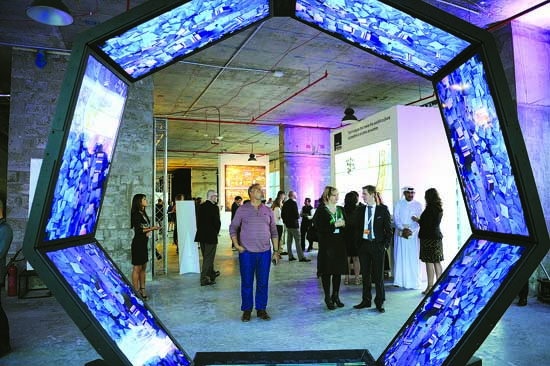
DOHA: A diverse collection of artworks by eight artists from around the world are displayed at the ‘Art Lab’ exhibition which runs alongside ‘The New York Times Art for Tomorrow’ conference at W Doha Hotel.
The exhibition, which gathers a selection of contemporary art installations, opened on the eve of the conference featuring luminaries from the art world. “I’m excited about it (the conference) and I’m privileged and honoured to be invited to come here. I think it is important for people to come together to exchange ideas. The more we get together and exchange ideas, the better our society will be, whether it has to do with politics, art or society. We can only benefit from exchanging ideas and understanding each other,” Prince Nikolaos of Greece and Denmark told this daily.
Nikolaos’s seascape photographs are one of the highlights at the exhibition. His ‘H2Orizons’ installation, created in collaboration with Soundwall, is a multi-dimensional triptych combining images he took of the Aegean Sea in Greece and music he curated.
Sheikh Hassan bin Mohammed bin Ali Al Thani, a prominent Qatari artist, scholar and art collector, is also one of the featured artists whose oeuvre blends traditional Qatari objects. He has played a pioneering role in cultivating and preserving modern and contemporary art in the Middle East and North Africa.
“Sheikh Hassan’s batoola installation ‘Motherland’ is very beautiful and evocative of Qatar and the Middle East,” said Louise Hunter, Managing Director, Summerhouse Media, and Curator of the exhibition. Hunter described the exhibition as “diverse, interesting and intriguing.
“For instance, Androulla Michael’s Deconstructed Selfie; the fact that it was made out of cotton pads she used as makeup remover is intriguing. It was made from something so simple, which shows art is all around us and we can make art out of almost anything,” she said.
Another feature of the exhibition is the Google Art Institute which allows visitors to delve into the world’s cultural treasures, putting over 200,000 art works and six million photos at their fingertips, before they take a journey in virtual reality. “The institute was born five years ago to provide access to culture to everywhere in the world, democratising access to culture, and work with cultural institutions to help them make the best of digital opportunities. Today, we have 1,000 partners, including museums and cultural institutions which allow users to have an experience around art and history,” said Giorgia Abeltino, Director, Public Policy at the institute.
The Peninsula






