DOHA: Against the backdrop of continuing funding constraints, the private sector capital is expected to play a bigger role in the Middle East’s infrastructure sector in long term, whether through Public-Private Partnerships (PPPs) or fully private-sector projects.
The findings of PwC’s fourth Middle East Capital Projects and Infrastructure survey suggest in the short term, there will be a mixture of private and government funding over the next 12 months and over the longer term private sector funding will continue to increase.
Against the background of constrained public finances, there is widespread belief that more private capital will be required to fund future projects, an impression reinforced by numerous government announcements seeking private sector involvement in capital projects across the whole region.
Respondents participated in the survey believe that private sector finance would be either important or very important for appropriate major infrastructure projects in the Middle East. “The public sector cannot continue financing all the required developments. Private sector financing is the only alternative to achieve sustainability” was typical of respondents’ comments on this topic. Half of respondents expect a mix of public and private capital to fund future projects.
Many contractors remain poorly capitalised and short of working capital. Without more stable finances, they will not be able to invest in the technology and other innovations that would enable them to increase efficiency to deliver better performance, the PwC survey found.
Private capital may well play a bigger role in financing future projects. In any case, there needs to be a much more effective collaboration between customers and contractors that recognises that contract awards based on “lowest cost wins” very often fail to secure the best ‘whole of life’ outcome in value terms. Lowest cost decisions give key players in the construction supply chain little capacity or incentive to invest in initiatives that would deliver better quality and value over time.
Maarten Wolfs, PwC Middle East Deals - Infrastructure and Government Leader said: “Governments across the region continue to face challenges and pressure to perform and extract the highest value from projects as possible. What this tells us is that the industry needs to evolve. This may be done through the entry of new competitors, new technologies or changes to regulation to facilitate the delivery of capex programmes.” “It is important that the lessons learnt about project management and governance is not forgotten about in the wake of increased spending, in doing to the industry may miss opportunities to improve long term performance.”
PwC survey showed that there are changes in the way major infrastructure projects in the Middle East are managed. Currently, project management is fully outsourced to consultants on about 80 percent-90 percent of projects, but clients are signalling that this is set to reverse with 46 percent of all respondents saying a fully in-house Project Oversight Team was the most effective way to deliver projects. However, within the subset of contractors, 79 percent indicated that this was the best way to deliver projects. This finding suggests a turn in the industry cycle: clients are now signaling that they are unhappy with outcomes from outsourced project management.
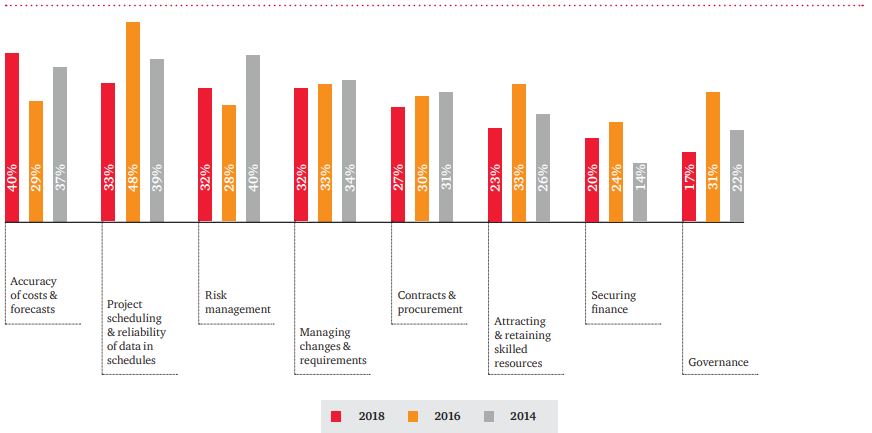
On the Project performance, the survey found overall, project time performance has improved with 34 percent of respondents indicating that projects are more than 6 months delayed compared to 47 percent in 2016. 36 percent of contractors surveyed have reported a decrease in profits, primarily driven by increased cost of materials, labour and equipment, along with challenges relating to working capital.