

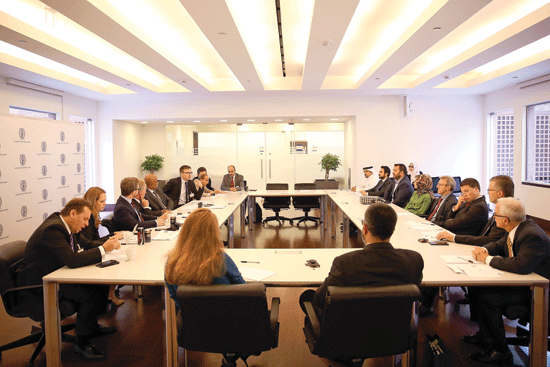
DOHA: A variety of topics related to Qatar were discussed at a special session at Georgetown University in Qatar (GU-Q) in Education City, attended by a delegation from Nato Parliamentary Assembly Science and Technology Committee.
A panel of GU-Q scholars and experts led by Dean Dr Gerd Nonneman took part.
The delegation comprised eight members of parliament from Germany, Norway, Italy, Romania and Estonia, and was led by Chairman of the Sub-Committee on Energy and Environmental Security, Jan Arild Ellingsen (Norway).
At the request of the assembly, GU-Q assembled an experts panel to provide an understanding of topics relating to Qatar’s economic, social, economic and military situation domestically and within the broader regional context.
Topics included Qatar-Nato relations, energy politics, cyber security, migrant issues, food and water security, work of the GCC in regional conflicts, as well as education and job diversification as part of Qatar’s bid to move away from over-dependence on energy resources.
“Diversification has been a buzzword in the region for two decades,” said Nonneman, in response to questions on the role of education in Qatar’s future development plans. Qatar Foundation’s investment in education aims to make the country a regional hub of excellence and build critical skill levels they will need to diversify the economy, so it makes perfect sense that it has become a key priority,” he added.
On benefit of Georgetown’s expert analysis and input on work of the assembly, Arild Ellingsen said: “We brought high expectations with us to the meeting, and Georgetown fulfilled all of them. The knowledge and expertise at GU-Q, including their ability to explain and share these complex ideas in a way that we are able to understand, is what makes their input so helpful to us.”
Prior to panel discussions, the delegation was taken to a tour of GU-Q’s high-tech purpose-built campus and facilities, including the largest library open for use by the public. The delegation was in Qatar for meetings with the Emir, ministers, government officials and representatives of the Advisory Council.
Since its creation in 1955, the assembly has provided a specialised forum for members of parliament from Atlantic Alliance to discuss and influence decisions on Alliance security. Through its work and activities, the assembly facilitates parliamentary awareness and understanding of the key issues affecting the security of the Euro-Atlantic area, and supports national parliamentary oversight over defence and security.
The Peninsula







