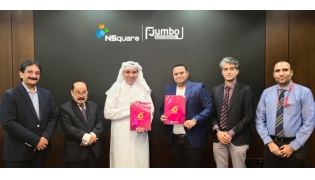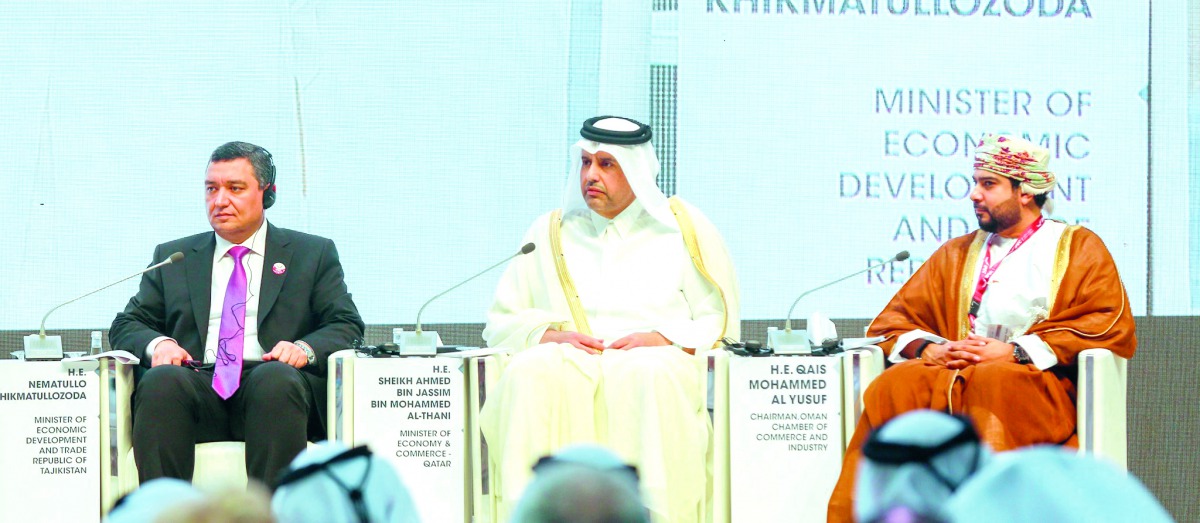
H E Sheikh Ahmed bin Jassim bin Mohammed Al Thani (centre), Minister of Economy and Commerce; Qais Mohammed Al Yusuf (right), Chairman, Oman Chamber of Commerce and Industry; and Nematullo Hikmatullozoda, Minister of Economic Development and Trade, Republ
DOHA: H E Sheikh Ahmed bin Jassim bin Mohammed Al-Thani, Minister of Economy and Commerce has said the massive participation of companies in the International Products Exhibition and Conference (IPEC Qatar) reflects the strength of Qatar’s friendly relations with participating countries and the important role that this international economic gathering plays in the region. Participating countries represent a market of 400 million people with significant purchasing power, Sheikh Ahmed said, noting that these countries have traded goods and services worth over $1 trillion with the rest of the world.
Participating in a panel discussion on “Qatar’s Sustainable Economic Growth in Cooperation with its Trade Partners”, on the opening day of IPEC, the Minister said the total trade volume between Qatar and participating countries is estimated at $5.5bn. “Participating countries have exported goods worth over $430bn, while total imports amounted to $540bn and the total trade volume between Qatar and these countries is estimated at $5.5bn”, he said.
The panel touched on initiatives and trade agreements with international partners and the promotion of joint investment between Qatar and the participating countries.
Sheikh Ahmed expressed hope in the development of bilateral trade agreements with the participating countries. Qatar and participating countries are bound by agreements concluded within the framework of the GCC and the Arab League, namely within the framework of the Greater Arab Free Trade Area.
Qatar could also capitalize on its agreements on economic and trade cooperation and the promotion and protection of mutual investments in addition to the Commercial Corridor Agreement between Qatar and Turkey through Iran, as well as the Trade and Economic Partnership Agreement between Qatar and Turkey.
Qatar’s economy made significant gains over the past one year, which demonstrate that the country has not only weathered the blockade, but was also able to turn a new page and open up to new markets.
Citing World Bank latest numbers on Qatar, the Minister said Qatar’s real GDP growth is expected to increase to 2.8 percent in 2018, while the inflation rate dropped from 2.7 percent in 2016 to 0.5 percent in 2017. Qatar’s foreign trade has also shown remarkable growth, increasing by 16 percent in 2017 while total exports increased by 18 percent, which resulted in a surplus of 49 percent in the trade balance. He added that the non-oil sector’s contribution to GDP also reached 52 percent in 2017.
He added that Qatar is also home to an investment and business-friendly environment, which allows foreign investors up to 100 percent ownership in numerous projects and permits non-Qataris to engage in trade activities. The government has also endeavored to develop free zones and modernize laws and regulations, which led to Qatar‘s ranking in the first place in the Arab world on the 2018 Global Entrepreneurship Index, issued by the Global Entrepreneurship and Development Institute 2018.