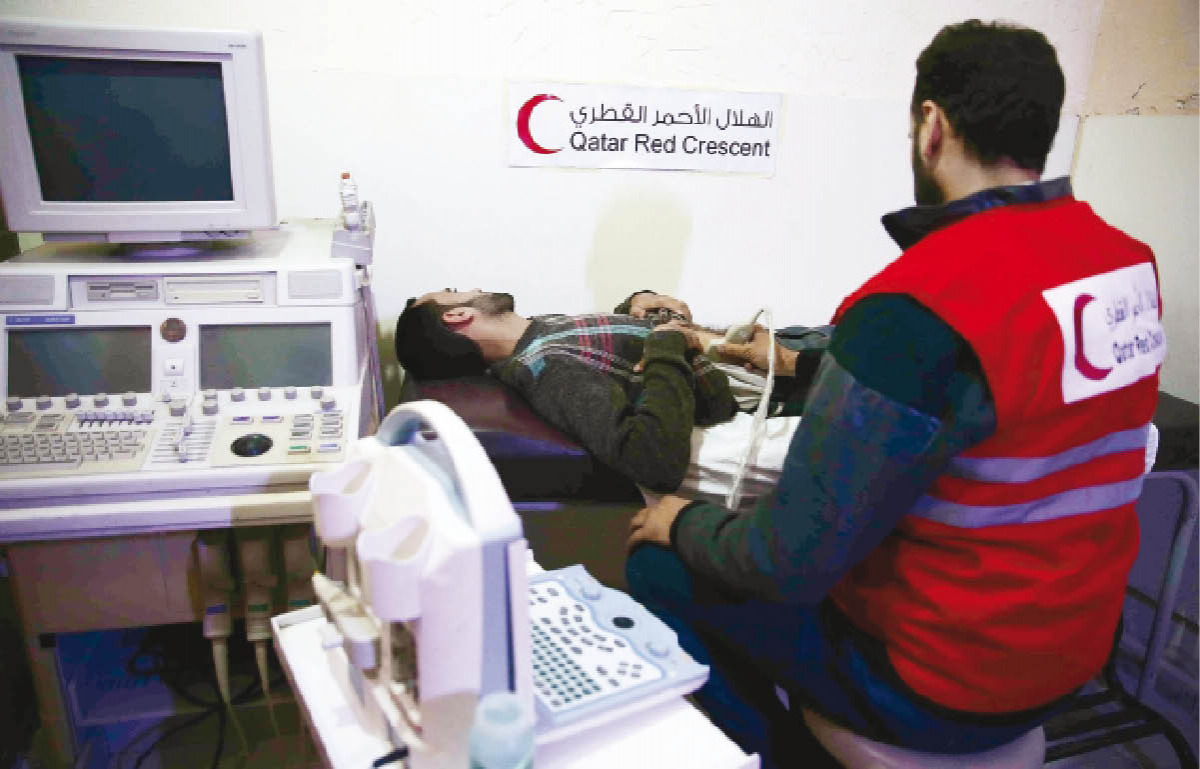
Doha: Qatar Red Crescent Society (QRCS) has received a donation of QR1m from Sheikh Khalid bin Hamad bin Abdullah Al Thani in support of its efforts to enhance the medical sector in Syria and provide treatment for thousands of patients and victims of the Syrian crisis.
The donation will go to a project for rebuilding, equipping and operating the healthcare centre in Darkush, a town in Idlib Governorate.
The project will serve about 70,000 residents and the displaced people from Lattakia and Aleppo.
The number of the beneficiaries is expected to rise as clashes are escalating, catalysing a wave of forced migration.
The project aims to offer primary healthcare, promote health awareness, reduce communicable diseases through early diagnosis and medication and vaccinate children in partnership with peers.
The outpatient centre in Darkush will be rehabilitated into a standard primary healthcare facility with specialities, including paediatrics, internal medicine, gynaecology and obstetrics, dentistry, dermatology, general surgery, orthopaedics, dressing and laboratory).
An agreement was signed with local authorities to issue a licence to the centre, and another with the local partner to avoid duplication of efforts and ensure integration of health services.
QRCS will offer primary healthcare services, and the partner will provide secondary healthcare.
QRCS will also undertake logistical tasks of rehabilitating buildings and infrastructure, connecting the water/power supply and sewerage system, procuring medical/stationery supplies, furnishing and installing equipment, securing medications, hiring and training medical and administrative staff, and coordinating with local and international medical institutions working there.
The project is in response to the critical humanitarian situation in the area, which weighed heavily on the medical sector.
Most health facilities in the area are out of service due to lack of funding or direct bombing. Transportation to farther towns is too difficult and risky compared to Darkush, which is the area’s largest and safest town.The Peninsula