

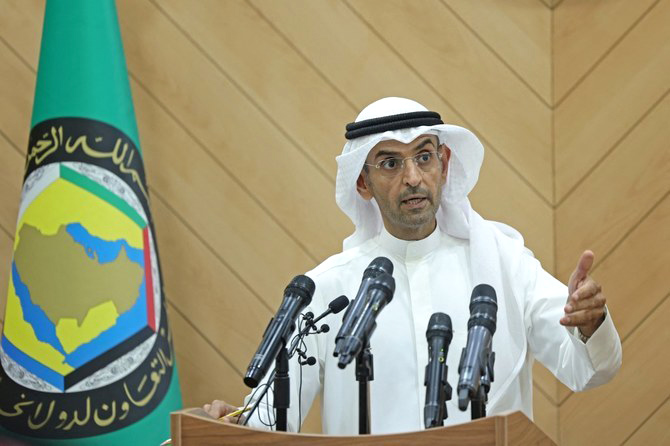
Nayef Falah Al-Hajraf, Secretary-General of the GCC, speaks during a press conference in Riyadh, recently.
The State of Qatar is looking forward that the two-month truce agreed between the parties to the conflict in Yemen, which began on Saturday on the first day of Ramadan, would pave the way for a comprehensive and lasting ceasefire in Yemen, and the involvement of all actors in the Yemeni scene, with the support of the international community, in the comprehensive political track and national reconciliation, in order to achieve the aspirations of the Yemeni people for security, stability and prosperity.
Qatar is always keen to provide full and continuous support to alleviate the humanitarian crisis in Yemen, help the brotherly people of Yemen to overcome the difficult circumstances that burden them, and support all international efforts aimed at advancing the solution through dialogue and achieving sustainable peace and development and improving the humanitarian situation in Yemen, in line with its policy to mitigate the effects of humanitarian crises.
This concern stems from its firm stance calling for a solution to the Yemeni crisis based on the Gulf initiative and relevant Security Council resolutions, especially Resolution No. 2216.
Qatar has also been keen to provide humanitarian assistance to the Yemeni people, including the priority sectors for food security, health and capacity building. Qatari humanitarian aid to brotherly Yemen has not stopped.
The directive of the Amir H H Sheikh Tamim bin Hamad Al-Thani in July 2021 to allocate USD100 million in support of the World Food Program in Yemen of the United Nations to support food security and stave off famine there, crowned this pioneering Qatari humanitarian presence in Yemen, Qatar’s support for Yemen reflects the extent of the close, historical, and strategic relationship between the two countries.
The total aid provided by Qatar to Yemen from 2013 to 2020 amounted to approximately USD 195 million.
In order to meet the food security needs in Yemen, in November 2021, the Qatar Fund for Development signed an agreement with the World Food Program to provide a financial contribution of USD 90 million to help meet urgent food security needs in Yemen, and averting the threat of famine, in addition to providing logistical support through the Humanitarian Air Service, to transport volunteers and staff to and from and within Yemen.
The Qatar Fund for Development (QFD) is also working with the United Nations Children’s Fund (UNICEF) to support the water and sanitation sector in Yemen, which in turn will contribute to rehabilitating water networks, improving access to healthy drinking water, and limiting the spread of diseases through contaminated water.
In December 2020, the QFD also signed an agreement in the health sector with the United Nations Population Fund, worth USD 5 million, to provide comprehensive health services to the most affected groups in 10 health facilities in Yemen, in addition to referring complex medical cases to Khalifa Hospital in the governorate of Taiz.
Sensing its responsibility and obligations, Qatar made an in-kind donation of seven tons of medical aid to Yemen through the World Health Organization in 2020, as part of efforts to respond to the repercussions of the Corona virus pandemic.
Qatari Red Crescent (QRCS), recently launched a project to treat unable patients in Yemen, benefiting 1,043 patients.
In parallel, at the headquarters of the Fund for the Care and Rehabilitation of the Disabled in Sana’a, with the support of the QRCS, work was launched on a project to support patients in Yemen, by providing compression garments and medicines for 290 cases of severe burns.
The Qatar Red Crescent also launched the “shelter” project in the governorates of Hodeidah and Raymah in Yemen, to provide adequate and safe shelter for 280 families of the most vulnerable displaced or returnees from displacement, over a period of 3 months, at a total cost of about half a million dollars.
Qatar also implemented housing project which includes construction of 211 building in two governorates, in addition to the restoration of 69 dilapidated residential buildings.
Last March was the most prominent month ever with regard to the most serious steps to solve the Yemeni crisis. On March 17, the General Secretariat of the Cooperation Council for the Arab States of the Gulf announced hosting Yemeni consultations to discuss the future of the crisis, with the participation of all concerned parties, which began on the 29th of the same month.
Secretary-General of the Cooperation Council for the Arab States of the Gulf, H E Dr. Nayef Falah Mubarak Al Hajraf, affirmed that Yemeni-Yemeni consultations under the auspices of the Council will be held at the headquarters of the General Secretariat in Riyadh from March 29 to April 7, with the aim of uniting the ranks among the Yemeni brothers, and in support of Yemeni legitimacy. strengthening state institutions.
These consultations come within the councils ongoing efforts aimed at ending the crisis in Yemen and bringing it to a stage of peace and national reconciliation, which meets the aspirations of Yemenis, in addition to restoring stability and ensuring decent living conditions for the Yemeni people.
These consultations are represented in a number of axes, foremost of which is the military and security axis, which includes the ceasefire at the level of Yemen, the protection of citizens, and the opening of humanitarian corridors, passing through the axis of the political process, which includes the comprehensive peace process and its foundations, to create an appropriate environment to reach a comprehensive and just political solution and sustainable, in addition to the axis of strengthening state institutions, administrative reform, governance and combating corruption.
The consultations aim to urge all Yemeni parties, without exception, to accept a comprehensive ceasefire, enter into peace consultations under the auspices of the United Nations with Gulf support, strengthen state institutions, enable them to perform their constitutional duties on Yemeni soil, and restore security, peace and stability to Yemen, confirmation of the position of the Cooperation Council on the crisis and the continuation of the GCC states in providing support to it in all fields, in addition to setting up sustainable Yemeni-Yemeni consultation mechanisms that establish the formation of a participatory political container from all political and civil components to unify the home front, until the desired peace is achieved.
The Yemeni-Yemeni consultations, with their six axes (political, economic, developmental, relief, humanitarian, social, and media), represented a platform for the people of Yemen to diagnose the reality, understand its difficulties, extrapolate the future, and prepare for its challenges, and formulate practical steps to move Yemen from a state of war and its horrors to a state of peace and its hopes.
The GCC affirmed a number of constants in the midst of a world of variables, foremost of which is the stable position of the GCC in supporting security and stability in Yemen and working to find a solution to the Yemeni crisis that ends the conflict and moves Yemen from a state of war and its repercussions to a state of peace and its challenges in accordance with the three references represented by the Gulf initiative and its mechanism and the outcomes of the comprehensive Yemeni national dialogue, and Security Council Resolution 2216, considering that the Riyadh Agreement represents a road map and a Yemeni national entitlement.
The conditions that the world is currently going through have proven beyond any doubt that the solution to the Yemeni issue will be a peaceful solution in the first place, and that the war and its seven years of hardship, with all the meaning of the word, cannot achieve the desired security and stability.
The efforts of the international community constituted international support to end the conflict in Yemen through Security Council resolutions and support everything that would achieve security and stability, this constitutes a historic opportunity that must be seized and built upon to preserve the Yemeni file as a priority that receives attention and follow-up from the international community until the war ends and the battle of construction and reconstruction begins.
On March 29, the Joint Forces Command of the Coalition (Coalition to Support Legitimacy in Yemen) announced the cessation of military operations inside Yemen, starting from the following morning (Wednesday), March 30.
This comes in response to the call made by Secretary-General of the Cooperation Council for the Arab States of the Gulf, Dr. Nayef Al Hajraf, to request a halt to military operations, coinciding with the launch of the Yemeni-Yemeni consultations, and with the aim of creating the appropriate conditions for the success of the consultations and creating a positive environment during the blessed month of Ramadan to make peace and achieve security and stability in Yemen.
The Joint Forces Command of the coalition announced its commitment to the ceasefire and will take all steps and measures to make the ceasefire successful, create appropriate conditions and create a positive environment during the holy month of Ramadan to make peace and end the crisis.
The leadership of the joint forces of the coalition in support of the legitimate Yemeni government affirmed the stability of its political stance and its military measures and procedures, also affirmed the support of the Joint Forces Command for the permanent alliance with the Yemeni people to achieve their aspirations and build their state in a manner that achieves security and prosperity.
The UN Special Envoy for Yemen, Hans Grundberg said on Friday that the aim of this two-month truce is to give Yemenis a necessary respite from violence, to alleviate human suffering, and most importantly, hope for an end to this conflict, stressing that he would press for a permanent ceasefire in Yemen.
UN Secretary-General Antonio Guterres stressed that the truce should be a first step to end the war in Yemen, urging the parties to the conflict to build on this opportunity to resume a full Yemeni political process that includes all.
The ceasefire truce stipulates the cessation of all military operations, including cross-border operations, allowing fuel ships to enter the port of Hodeidah, operating commercial flights coming to Sanaa airport, and leaving “to predetermined destinations in the region.”
The firm declared position of the Council and what it has done since the beginning of the crisis, is based on the decisions of the Supreme Council. Their Majesties and Highnesses directed the leaders of the Council at the 36th session of the Supreme Council, which was held in Riyadh in December 2015, to set the necessary mechanisms and programs for Yemens integration into the Gulf economy, organizing an international conference for the reconstruction of Yemen once the desired political solution is reached.
At the 42nd session of the Supreme Council, held in December 2021, the leaders of the Gulf Cooperation Council stressed the importance of finding a comprehensive political solution to the Yemeni crisis. They also affirmed the councils permanent keenness to defuse the conflict between the Yemeni brothers to bring Yemen to safety in response to the aspirations of its honorable people. The Gulf Cooperation Council believes that the solution to the crisis is in the hands of the Yemenis themselves. Yemen, as stated by Secretary-General of the GCC for the Arab States of the Gulf, Dr. Nayef Falah Mubarak Al Hajraf, is an authentic part of the Arab and Gulf surroundings and is linked to its neighbors by the unity of belonging, roots, geography, religion, and lineage.





