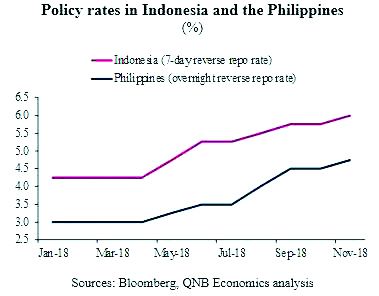
Monetary authorities in Indonesia and the Philippines have recently led some of the most aggressive policy tightenings in emerging Asia. In fact, Bank Indonesia (BI) and Bangko Sentral ng Pilipinas (BSP) have lifted their policy rates by 175 basis points (bps) since May 2018. While the pace and magnitude of rate hikes make the tightening cycles in both Indonesia and the Philippines look similar, the drivers for policy actions have been different.
QNB’s weekly ‘economic commentary’, which delved into each of these cases, noted that BI’s actions are designed to support the currency while reducing the country’s external vulnerabilities.
Importantly, there is no sign of domestic capacity constraints as GDP growth is below potential and inflation is running within the central bank 2.5 – 4.5 percent target. Macroeconomic imbalances in Indonesia are rather manifested on the external sector. Higher spendings than incomes in the non-financial corporate and government sectors have been producing persistent current account deficits since 2011. The deficit has widened recently from 0.9 percent of GDP in Q4 2016 to 3.4 percent in Q3 2018.
Moreover, the external stock balance is negative. The net international investment position (NIIP) of the country, which reflects the stocks of foreign assets and liabilities of residents, reads a negative $306bn or 30.0 percent of GDP. This means that Indonesians are in aggregate net debtors to the rest of the world. Net foreign liabilities are concentrated in non-financial corporations and the government. Crucially for FX, there is a substantial amount of long-term portfolio debt liabilities to non-residents denominated in local currency.
Given all of the above, Indonesia is particularly sensitive to non-resident portfolio capital flows. As the US Federal Reserve stays on course for monetary policy normalization and US bond yields rise, the BI has to follow through or even anticipate hikes to maintain or increase the interest rate differential, i.e., the difference between domestic rates or yields and other benchmarks such as US Treasuries. This is what is behind BI governor Perry Warjiyo’s ‘preemptive, front-loaded and ahead of the curve’ approach. Higher yields should favour domestic assets and thus prevent or limit capital outflows.
Policy actions have so far boosted BI’s credibility and the Indonesian Rupiah (IDR) has rebounded in recent weeks. While the IDR is still down 6.8 percent against the USD year-to-date (YTD), it has appreciated 4.9 percent since late October. Additional hikes are expected and will follow the evolution of the US monetary policy and risk sentiment. The current account gap is not expected to narrow substantially before H2 2019, as imports are currently sticky and exports are negatively affected by lower commodity prices and softer Asian growth.
In the Philippines, on the contrary, the BSP’s actions are designed primarily to prevent overheating and anchor inflation expectations. Macroeconomic imbalances in the Philippines are indeed mostly manifested internally. Over the last years the GDP has been growing above potential, which creates capacity constraints and inflationary pressures. Both unemployment and manufacturing spare capacity are close to all time record lows at respectively 5.4 percent and 15.8 percent.
Headline CPI inflation has reached a nine-year high of 6.7 percent y/y in recent months, considerably above the central bank 2 – 4 percent target. Core CPI inflation, which excludes food and energy prices, is also high at 4.6% y/y. Rice, the staple food in the country and the second-largest item in the CPI basket with a weight of nearly 10 percent of total, has been the key culprit for high headline inflation.
Rice prices soared to 10.1 percent y/y in October from 1.4 percent early in the year as Super Typhoon Mangkhut devastated crops and created supply shortages.
The government is trying to ease the pain with emergency imports of rice, but prices are likely to respond gradually to supply normalization over the coming months. A plethora of other exogenous and temporary factors, including oil prices and the impact of recent indirect tax hikes on high-sugar drinks, fuel, tobacco and beverage, also had their contribution. Minimum wage growth and transport rate hikes were an additional factor more recently.
BSP’s credibility has also been boosted after the recent hikes. Inflation is expected to come down towards the target next year, with the BSP forecasting a 3.5 percent rate in 2019. The external environment is set to be supportive as oil prices have already started to go down substantially. The Philippine Peso has also rebounded by 3.4 percent in recent weeks, even if it is still 5.2 percent down YTD.
In short, strong monetary policy actions in Indonesia and the Philippines were important to increase central bank credibility during a period of shocks. However, the root causes for action differed in both countries. In Indonesia, the main objective is to tackle external imbalances and cover for current account deficits and foreign liabilities, while in the Philippines actions are targeting internal imbalances to curb inflationary pressures.