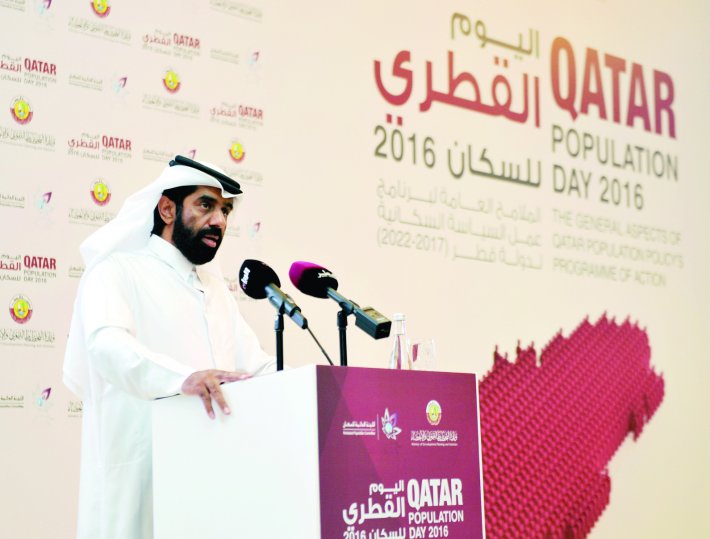
H E Dr Saleh Mohamed Salem Al Nabit, Minister of Development Planning and Statistics, at the opening session of Qatar Population Day in Four Seasons Hotel yesterday. Pic: Abdul Basit/ The Peninsula
Several development and population changes have occurred since the launch of Qatar Population Policy work programme in 2009, making it necessary to re-evaluate the goals of the population policy as well as its targets and procedures, the Minister of Development Planning and Statistics H E Dr Saleh bin Mohammed Al Nabit said yesterday.
He added that it has became necessary to evaluate the experience of the Permanent Population Committee in the implementation of the aforementioned procedures.
The minister was speaking at event held by the Ministry of Development Planning and Statistics to mark 8th Qatar Population Day 2016. The event marked under the title: general features of the work program of the population policy of the State of Qatar (2017-2022).
Al Nabit pointed out that the Permanent Population Committee was keen to engage the Qatari society in judging the compatibility of the objectives and the specified procedures in the approved work program to the aspirations of the country's population and its development goals.
The aim of the Population Policy 2017 -2022 includes increasing the number of nationals, supporting orientation towards knowledge economy and controlling recruitment of expatriate workers, said Captain Abdullah Al Mohannadi, a member of the Permanent Committee in his presentation entitled “population and labour forces”.
Maintaining a balance between nationalities in job distribution and getting rid of redundant work force are also part of the goals and aims set up for forthcoming population policy, he added.
Low birth rate, low fertility and increase of the average childbearing age of Qatari women are the challenges highlighted by the two-year population assessment study carried out by the Permanant Committee. The assessment also indicated population challenges related to non-Qataris including high growth rate, disruption of demographics, imbalance of population distribution and imbalance of lobour market.
Loay Shabana from the regional office of the UNDP lauded the population policies of Qatar saying this year Qatar played outstanding role by hosting several events related to population.
On the sidelines of the event the Regional Office of the UNFPA in the Arab Region and the Qatar Foundation for Social Action, signed a Memorandum of Understanding (MoU) for setting a framework for cooperation between the two sides.
The MoU also covers work on issues such as youth, social system and social protection and issues related to the use and provision of data through social networks as one of the core tributaries to monitoring sustainable development.